


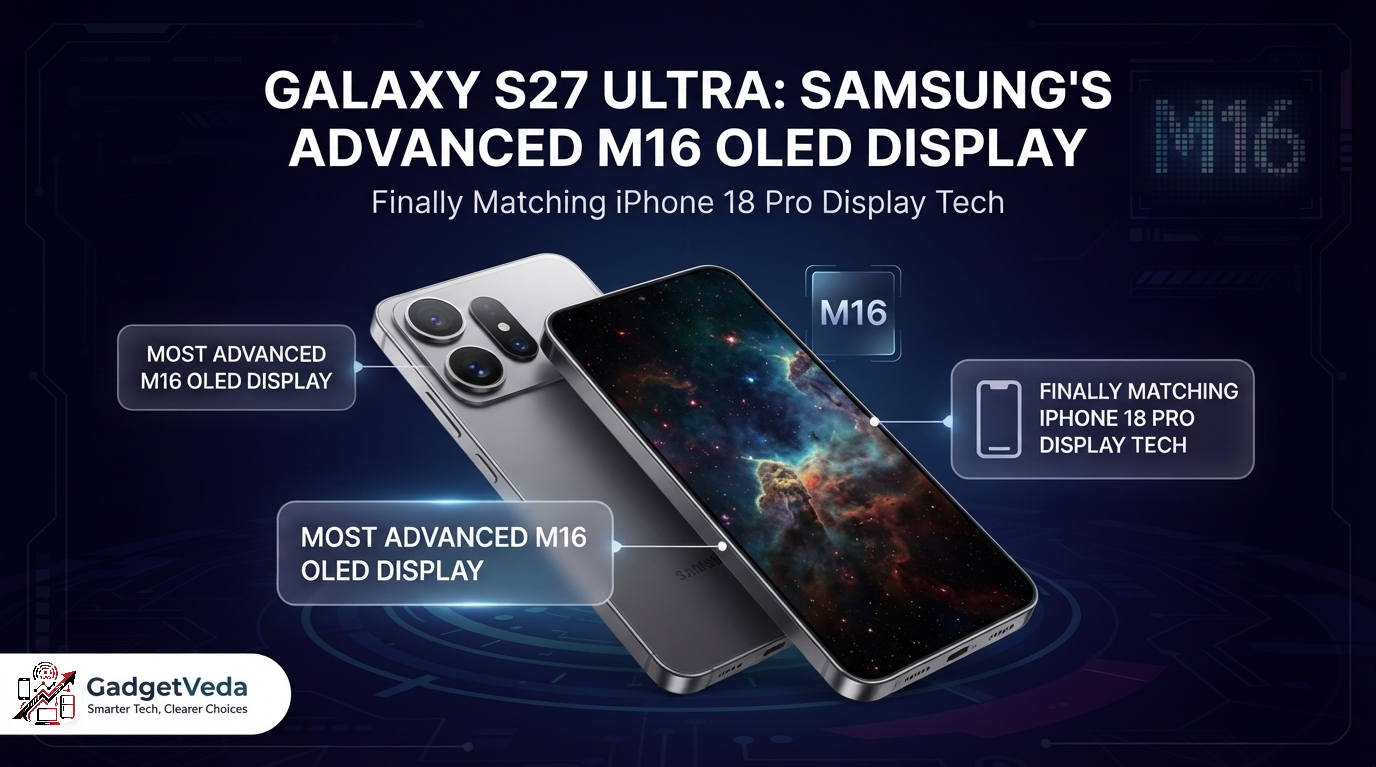
New Delhi, 13 September 2026 — Samsung is set to end a three-year display drought on its flagship lineup. According to a fresh report from South Korean outlet ETNews, the Galaxy S27 Ultra and the newly introduced Galaxy S27 Pro will be the first Samsung-branded phones to ship with the company’s cutting-edge M16 OLED panel, a material Samsung Display has so far reserved almost exclusively for rival devices.
Samsung Finally Uses Its Own Best Tech On Its Own Phones
For years, Samsung has followed an unusual pattern: build the industry’s most advanced OLED panels, then hand the newest material to competitors first while its own Galaxy S series runs on generation-old tech to keep costs down. That pattern is reportedly ending with the Galaxy S27 series. The M16 panel has already appeared on Apple’s iPhone 18 Pro and Pro Max, as well as on Google’s Pixel 11, both of which launched before Samsung’s own flagships get the same glass. Vivo’s iQOO 16, expected to launch in China later this month, will also carry M16 panels.
Bringing M16 to the Galaxy S27 Ultra and S27 Pro closes that gap for the first time since Samsung’s own screens started trailing what it supplies to outside brands. The material reportedly delivers meaningful gains in peak brightness, power efficiency, colour accuracy and long-term panel lifespan compared to the M14 and M13 generations used on recent Galaxy flagships.
💡Also explore on GadgetVeda: our curated buying guide on Best Smartphones Under ₹30,000 In India, and Best Tablets Under ₹20,000 For College Students and Casual Gaming.
Privacy Display And Polarizer-Free Tech Carryover
The upgrade isn’t limited to raw brightness and efficiency numbers. Samsung is pairing the new M16 material with Color Filter-on-Encapsulation (COE) technology, which eliminates the need for a traditional polarizer layer, and with an enhanced version of Privacy Display, Samsung’s screen-dimming tech that electronically blocks side-angle viewing without requiring a physical privacy screen protector. The Galaxy S26 Ultra was the only mainstream smartphone offering both COE and Privacy Display this generation, and extending these features to the Galaxy S27 Pro marks the first time a non-Ultra Galaxy model gets access to this display tier.
Hopefully, this generation also resolves the red-tint display complaints that some Galaxy S26 Ultra units faced after launch, an issue Samsung has yet to fully address across all affected units.
A Four-Way Split Across The Galaxy S27 Lineup
The display upgrade doesn’t apply uniformly across the entire S27 family. Reports indicate a clear two-tier structure: the standard Galaxy S27 and Galaxy S27+ will move up from the older M13 material to M14 OLED glass, the same panel used on last year’s Galaxy S26 Ultra. Meanwhile, the Galaxy S27 Pro and Galaxy S27 Ultra get exclusive access to the newer M16 material along with COE filtering and Privacy Display.
Screen sizes are expected to follow a similarly tiered structure: the Galaxy S27 at 6.27 inches, the Galaxy S27+ at 6.66 inches, the Galaxy S27 Pro at 6.47 inches, and the Galaxy S27 Ultra topping the range at 6.89 inches. This is also the first time Samsung has introduced a “Pro” model into the Galaxy S lineup, positioning it between the Plus and Ultra variants rather than replacing either.
Samsung Galaxy S27 Ultra: Chipset And Other Expected Upgrades
Beyond the display, the Galaxy S27 Ultra is widely tipped to run on Qualcomm’s Snapdragon 8 Elite Gen 6 Pro chipset, built on a 2nm or 3nm process depending on the source, with 12GB of RAM and a battery capacity expected between 5,200mAh and 5,700mAh. Camera specifications are rumored to include a 200-megapixel primary sensor alongside 50-megapixel ultra-wide and telephoto units. Some reports also suggest Samsung is evaluating an Exynos 2700 chipset for select markets on the Ultra, though the US is still expected to get the Snapdragon variant across the board. None of these chipset or camera details have been officially confirmed by Samsung, and the company has not announced a launch date, though the Galaxy S27 series is widely expected to debut in the first quarter of 2027.
The reported OLED upgrade will also reportedly extend to Samsung’s foldable lineup later in 2027, with the Galaxy Z Flip 9, Galaxy Z Fold 9 and Galaxy Z Fold 9 Ultra all tipped to move away from M13 glass toward M16 panels.



![12 Best Earbuds Under ₹3,000 in India [2026] | GadgetVeda](https://gadgetveda.com/wp-content/uploads/2026/09/Best-Earbuds-Under-₹3000-in-India-150x150.webp)
![11 Best Washing Machines Under ₹50,000 in India [2026]](https://gadgetveda.com/wp-content/uploads/2026/09/Best-Washing-Machines-Under-₹50000-in-India-150x150.webp)
![14 Best Wireless Earbuds Under ₹2,000 in India [2026]](https://gadgetveda.com/wp-content/uploads/2026/09/Best-Wireless-Earbuds-Under-₹2000-in-India-150x150.webp)
![10 Best Wireless Earbuds Under ₹1,000 in India [2026]](https://gadgetveda.com/wp-content/uploads/2026/09/Best-Wireless-Earbuds-Under-₹1000-in-India-150x150.webp)


![12 Best Earbuds Under ₹3,000 in India [2026] | GadgetVeda](https://gadgetveda.com/wp-content/uploads/2026/09/Best-Earbuds-Under-₹3000-in-India-300x167.webp)
![11 Best Washing Machines Under ₹50,000 in India [2026]](https://gadgetveda.com/wp-content/uploads/2026/09/Best-Washing-Machines-Under-₹50000-in-India-300x167.webp)
![14 Best Wireless Earbuds Under ₹2,000 in India [2026]](https://gadgetveda.com/wp-content/uploads/2026/09/Best-Wireless-Earbuds-Under-₹2000-in-India-300x167.webp)
![10 Best Wireless Earbuds Under ₹1,000 in India [2026]](https://gadgetveda.com/wp-content/uploads/2026/09/Best-Wireless-Earbuds-Under-₹1000-in-India-300x167.webp)