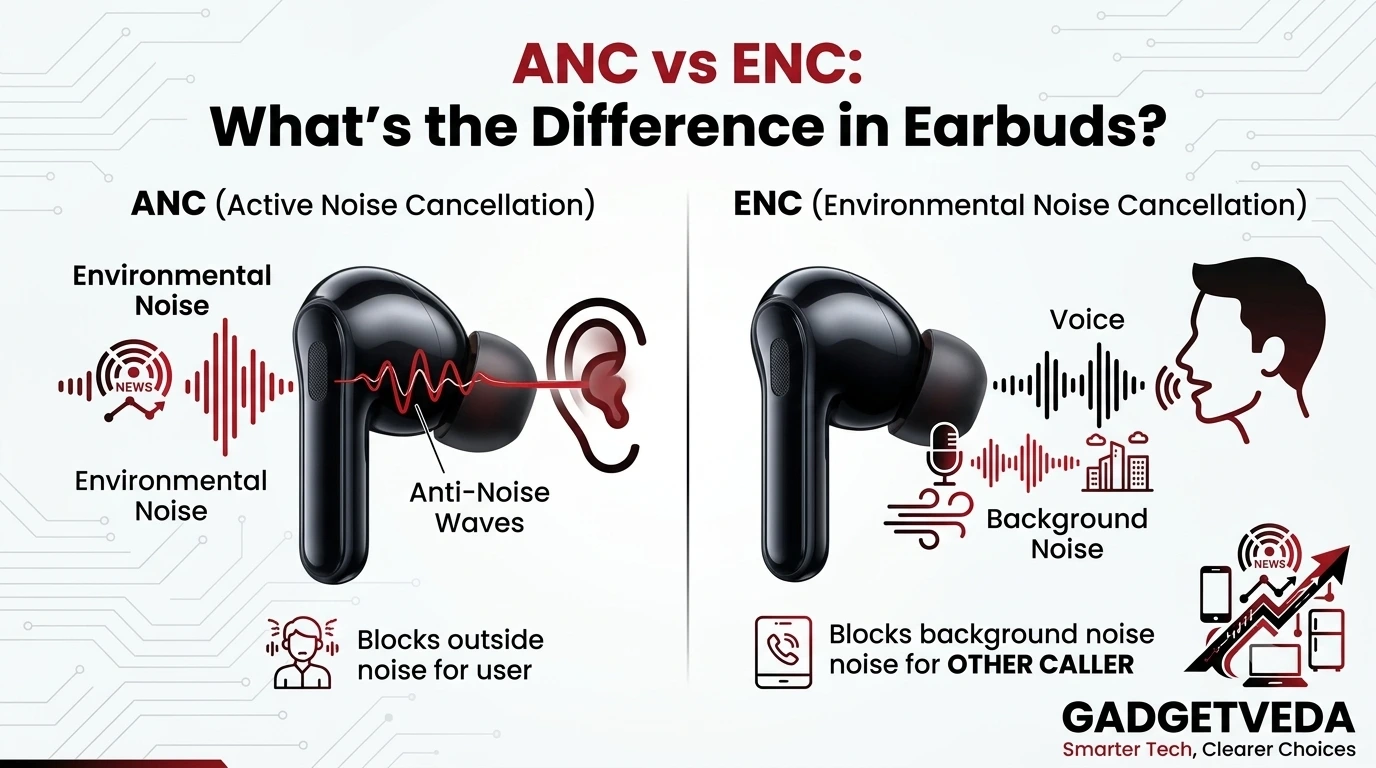
ANC reduces background noise reaching your ears. ENC reduces background noise picked up by your microphones so the person on the call can hear you more clearly. One improves your listening environment; the other improves your outgoing voice signal.
That difference gets blurred on budget-earbud listings. “AI noise cancellation”, “quad-mic ENC” and “up to 45 dB ANC” can appear together as though they describe the same upgrade. They do not. Earbuds can make your voice clearer without making your commute quieter, and they can reduce train rumble while still delivering disappointing calls.
Before paying extra, identify your actual problem: are you struggling to hear your music, or are other people struggling to hear you? At GadgetVeda, that is where this comparison starts—not with the longest feature list.
ANC vs ENC: The Difference at a Glance
| Feature | ANC | ENC |
| Full form | Active Noise Cancellation | Environmental Noise Cancellation |
| Main purpose | Reduce unwanted sound you hear | Reduce unwanted sound in your outgoing microphone audio |
| Who benefits directly? | You, the earbud wearer | The person listening to your voice |
| How it works | Microphones and processing generate anti-noise through the speakers | Microphones and processing separate speech from background noise |
| Main situations | Commuting, travel, music, and focused listening | Phone calls, online meetings, and voice chat |
| Important limitation | Does not guarantee silence or good call quality | Does not make your surroundings quieter to your ears |
| What to verify | Noise reduction, fit, comfort, and ANC-on battery life | Voice intelligibility, background suppression, and wind performance |
Neither technology is a higher version of the other. Good earbuds can combine both, but their listening performance and microphone performance still need separate evaluation.
What Is ANC in Earbuds?
Active Noise Cancellation uses microphones, processing and the earbud speakers to reduce external sound at your ears. It is an active electrical system, not simply the muffling effect of putting something in your ear.
How active noise cancellation works
Think of the steady rumble inside a bus. ANC microphones pick up sound, and the processing system calculates an opposing sound signal. The earbud driver plays that signal alongside your audio.
When the unwanted sound and the correctly timed opposing signal meet, their pressure variations partly cancel. Engineers call this destructive interference. In a simplified example, a positive pressure change meets a corresponding negative one.
Real earbuds do more than flip an entire recording upside down. Their filters must account for timing, microphone placement, the driver, and the acoustic path to your ear. The result is local noise reduction near your ears—not a quieter bus for everyone else.
That is why the chip alone cannot tell you how well the product works. Microphones, tuning, fit and physical design are all part of the system.
What ANC reduces most effectively
ANC is generally strongest against steady, low-frequency noise. Typical examples include:
➡️ The low rumble of a moving train.
➡️ Bus and aircraft engine drone.
➡️ The lower-frequency component of ventilation noise.
➡️ A persistent background hum in an office.
Voices, horns, clattering utensils, and sudden announcements are more complicated. They contain changing frequencies and sharp transitions. Some capable systems reduce parts of these sounds substantially, but “ANC” alone does not promise that result.
The useful expectation is less background noise, not complete silence. A fan can sound thinner rather than disappear: its low hum may fall while blade noise and airflow remain audible.
Feedforward, feedback, and hybrid ANC explained
| ANC design | Microphone arrangement | What it contributes |
| Feedforward | Microphones monitor sound outside the earbud’s sealed listening space | Detects external noise for the cancellation system |
| Feedback | An inward-facing microphone monitors sound inside the listening space | Helps the system respond to the sound remaining near the ear |
| Hybrid | Combines outward- and inward-facing monitoring | Gives the controller both external and internal information |
Hybrid ANC offers more information to work with, but implementation still decides the result. A hybrid label is not an independent test score, and it does not make microphone quality, fit or tuning irrelevant.
Adaptive ANC is another term you may encounter. It describes a system that adjusts cancellation in response to changing conditions. It is not a replacement name for hybrid ANC: adaptation describes control behavior, while hybrid describes the microphone arrangement.
💡 On GadgetVeda: Explore our feature on Best Wireless Earbuds Under 1000 for smooth calling, streaming videos, and listening to music. For more promising options, we also have a guide on Best Wireless Earbuds Under 2000 and Best Wireless Earbuds Under 3000 in India.
What Is ENC in Earbuds?
Environmental Noise Cancellation usually refers to microphone noise reduction for calls in consumer-earbud marketing. Its aim is to preserve your speech while reducing the surrounding sound transmitted with it.
ENC does not normally play anti-noise into your ears to make listening quieter. It cleans up the signal leaving your microphones.
Imagine taking a call beside a ceiling fan. Effective ENC may make the fan less noticeable to the other person. You will still hear the fan yourself unless the earbuds’ physical seal, ANC or another listening feature reduces it.
How environmental noise cancellation works
The exact system varies, but a typical processing chain looks like this:
➡️ Microphones capture your speech and surrounding sound.
➡️ Processing analyses the signal for speech and noise.
➡️ Multi-microphone systems may use differences in arrival time and level to favor sound from your mouth.
➡️ Noise suppression reduces unwanted components before the audio reaches the caller.
The directional processing in step three is often called beamforming. It can help focus microphone pickup without requiring a long microphone boom beside your mouth.
There are limits. A nearby person speaking, a sudden horn or strong wind can be difficult to separate from the sound you want to keep. Aggressive suppression can also make your own voice thin, metallic or intermittent.
The goal is not merely to remove the most background sound. It is to keep your words understandable while doing so.
Is AI ENC different from ordinary ENC?
“AI ENC” suggests that machine-learning-based processing is involved in distinguishing speech from noise. It does not tell you how well that processing works in your voice, your language or your environment.
Similarly, terms such as AI calling, clear-voice technology and proprietary call-noise reduction identify a feature family, not a directly comparable performance rating.
Check what the feature is supposed to improve. If the explanation only discusses microphone pickup or clearer calls, do not assume it includes listening-side ANC.
Does ENC activate automatically?
On many earbuds, call-noise processing operates automatically when the headset microphone is being used. There may be no ENC toggle in the companion app. Availability can still depend on the model and the calling or recording mode.
That is different from ANC, which commonly has selectable listening modes such as ANC, transparency, and off. Check the manual rather than assuming every noise-related feature shares one switch.
Passive Isolation and Transparency: Two More Terms to Know
Passive isolation is the physical barrier
A well-fitting ear tip reduces incoming sound without analyzing it or generating anti-noise. This is passive noise isolation.
It works alongside ANC. A secure seal can improve both bass reproduction and the overall reduction of outside noise; a poor fit can undermine the result even when the electronics are capable.
This is why ENC-only earbuds can seem quieter than wearing nothing. The reduction may come from their ear tips, not from ENC doing ANC’s job.
Try the supplied tip sizes in each ear rather than automatically choosing medium. Your left and right ears may need different sizes. Choose a comfortable seal, not the largest tip you can force into place.
Transparency mode deliberately lets sound in
Transparency, ambient, or hear-through modes use microphones and processing to make outside sound more audible while you wear the earbuds.
They serve the opposite listening purpose to ANC. Useful examples include hearing a colleague or a station announcement without repeatedly removing the earbuds.
Transparency quality varies, and it does not guarantee normal directional hearing or road awareness. Do not treat it as permission to ignore traffic or use distracting audio in situations that require your full attention.
Why Strong ANC Can Still Mean Poor Calls
Listening-side cancellation and outgoing voice processing operate on different problems.
An earbud might reduce engine rumble effectively but struggle to separate your voice from nearby conversation. Another might transmit clear speech while leaving you exposed to much of the surrounding noise.
During a call, think of the two directions separately:
➡️ Incoming: the other person’s voice plays through your speakers. Your fit and available ANC affect how clearly you hear it over your surroundings.
➡️ Outgoing: your microphones capture your voice. Microphone design and call-noise processing affect what the other person hears.
The behavior can change in call mode. Some earbuds keep ANC available, some alter it, and others restrict their listening modes. A listening-mode demonstration during music playback does not establish how the earbuds behave in a meeting.
Phone software and meeting apps can add another layer of noise suppression. A clean call therefore reflects the whole chain, not necessarily the earbuds alone. Compare products using the same device, app, and settings where possible.
What ANC and ENC Mean in Indian Everyday Use
| Situation | Prioritise | Set this expectation |
| Delhi Metro, local train or bus commute | ANC, secure fit and comfort | Expect more relief from rumble than from every voice, horn or brake squeal |
| Calls beside a ceiling fan | Microphone noise suppression | Check whether speech stays natural and complete, not just whether the fan becomes quieter |
| Work-from-home meetings | Proven microphone quality; add ANC if your room is noisy | You need to hear the meeting and transmit your voice clearly |
| A crowded cafe | Both, judged separately | Nearby speech can challenge outgoing voice processing even when listening ANC feels effective |
| Walking outdoors | Wind performance and awareness | Moving air can disturb exposed microphones; neither badge guarantees good outdoor calls |
| A quiet bedroom | Comfort, tuning and battery life | Stronger cancellation may solve little if background noise is already low |
A commute contains several different noise problems at once. Low engine rumble, wheel noise, announcements and conversation should not be treated as one uniform “traffic noise” category.
Likewise, a high-speed ceiling fan creates both mechanical sound and moving air. If air is blowing directly across the earbud microphones, the call test is partly a wind test—not just a test of removing a steady hum.
How to Read Budget-Earbud Marketing Without Getting Misled
1. “Noise cancellation” is incomplete information
Look for the full wording. Does the product specify Active Noise Cancellation, or does it only mention noise cancellation for calls?
“Quad-mic ENC” does not establish that ANC is present. A clear feature description, manual and listening-mode controls are stronger evidence than a crowded promotional image.
2. More microphones do not automatically mean clearer speech
Four or six microphones can support different roles across a pair of earbuds. Some may serve ANC, others voice pickup, and some may support more than one function.
The total count alone does not tell you how many microphones remain available when you use only one earbud. Nor does it reveal their placement, wind protection or processing quality.
Treat microphone count as a design detail. Treat a consistent, intelligible noisy-call recording as performance evidence.
3. “Up to 45 dB ANC” is not a whole-world reduction
A headline ANC figure may describe the strongest measured reduction under specified conditions. It does not, by itself, tell you the reduction across the whole audible range.
For example, an advertised peak reduction against a low-frequency test sound cannot be assumed to apply equally to speech, a horn, and a train’s braking noise.
Ask what frequencies and test conditions the claim covers. Independent frequency-response attenuation measurements are more informative than a single maximum number.
Also, do not compare an ENC noise-reduction number directly with an ANC number. One concerns microphone output, while the other concerns sound reaching the listener. They describe different signal paths and may use different measurement methods.
4. “99% noise reduction” needs a defined measurement
Without knowing what was measured, across which frequencies, and whether the claim concerns listening or calling, the percentage is not enough to predict your experience.
Do not translate it into “99% silence” or assume it describes perceived loudness. Ask for the test definition rather than doing arithmetic on an undefined claim.
5. Compare battery life with ANC enabled
ANC requires active microphones and processing, and manufacturers commonly publish different runtimes with cancellation on and off.
For a real example of the scale—not a universal rule—one premium earbud specification lists up to eight hours of playback with noise cancellation on and twelve with it off. Your own shortlist may show a smaller or larger difference.
Keep three figures separate: a single earbud charge, additional charging-case top-ups, and talk time. A large case-inclusive total does not tell you whether one charge will cover a long meeting.
6. “AI” does not replace a difficult test
A product description cannot reveal whether the system clips the first word of a sentence, suppresses a soft voice, or struggles when another person speaks nearby.
Listen for those problems in realistic microphone samples. The absence of background noise is not a success if half your sentence disappears with it.
How to Test ANC and ENC Before Keeping Your Earbuds
Check the seller’s return and replacement conditions before buying. Do not assume that disliking the noise cancellation qualifies for a return.
Test ANC without letting music hide the result
➡️ Fit the earbuds securely and select the correct tip sizes.
➡️ Sit safely near a steady source such as room ventilation—not beside dangerously loud machinery.
➡️ Pause playback and switch between ANC off and on, if the model supports this.
➡️ Listen for a genuine reduction in low-frequency noise.
➡️ Repeat with quiet music at the same volume.
➡️ Check whether voices remain, and whether hiss or discomfort makes the mode unpleasant.
Keep your surroundings and fit consistent. Comparing ANC-on in a quiet room with ANC-off outdoors tells you little.
If a model will not enable ANC without playback, use the same quiet track and volume for both settings. The aim is to compare cancellation, not how effectively loud music covers noise.
Test ENC through the actual call path
➡️ Make a call using the phone or meeting app you normally use.
➡️ Confirm that the Bluetooth earbuds are the selected microphone.
➡️ Test in a quiet room, under a fan, and in a safely chosen noisier location.
➡️ Speak full sentences at a normal level and include short pauses.
➡️ Ask the other person to describe word clarity, voice naturalness, and remaining noise.
➡️ If recording the call is permitted and everyone agrees, compare samples using the same setup.
A generic voice-recorder app is not automatically a reliable substitute. Confirm which microphone it records and whether it uses the same processing path as your calls.
Repeat the test with one earbud if that is how you normally attend meetings. Do not assume single-earbud performance matches using both.
Listen for these microphone problems
➡️ Missing beginnings or endings of words.
➡️ Speech turning robotic when noise increases.
➡️ A quiet voice disappearing during pauses.
➡️ Nearby conversation competing with your speech.
➡️ Wind bursts overwhelming the recording.
The best result balances intelligibility, voice quality, and noise reduction. The quietest background is not necessarily the best call.
Which Should You Buy: ANC or ENC Earbuds?
For frequent commuting, prioritize effective ANC
Look for convincing listening tests, a secure fit and sufficient battery life with ANC enabled. Then check microphone performance separately if you take calls while traveling.
Do not pay more simply to move from one advertised dB figure to a larger one. The improvement should be audible in the kinds of noise you actually encounter.
For calls and online meetings, prioritize microphone performance
ENC is relevant, but the label is only a starting point. Look for real noisy-call samples and tests in the apps you use.
If most of your day is meetings, also consider a headset with a well-positioned boom microphone. That is an option worth comparing, not a guarantee that every boom headset outperforms every earbud.
For mixed use, demand evidence for both
Earbuds offering ANC and ENC can address both needs, but one feature cannot compensate for poor implementation of the other.
Make two separate judgments: “Does this reduce the noise I hear?” and “Can the other person understand me?” A product that passes only one is a compromise, not an all-rounder.
For a strict budget, avoid paying for the wrong solution
If you mostly listen at home, a comfortable, well-tuned pair with a good seal may be more useful than an uncomfortable ANC model. If calls are your priority, clear speech matters more than a premium-sounding listening feature you rarely use.
Our buying rule: decide which side of the conversation has the noise problem, then pay for the feature that addresses that side.
Does Noise Cancellation Protect Your Hearing?
Well-fitting noise-canceling earbuds can reduce the temptation to turn up music in noisy places. That is a useful benefit, but safe listening still depends on volume and duration.
Consumer ANC is not automatically certified hearing protection. Do not substitute ordinary earbuds for appropriate protective equipment around hazardous machinery, fireworks or other dangerously loud sound.
Keep playback moderate, take breaks, and stop listening if you experience discomfort. If ringing, muffled hearing or other symptoms persist, seek professional advice rather than changing cancellation modes and continuing.
FAQs
1. Is ENC better than ANC?
Neither is universally better. ENC targets noise in your outgoing microphone audio; ANC targets noise reaching your ears. Choose according to whether your main need is clearer calls or quieter listening.
2. Do ENC earbuds cancel noise while playing music?
Not through call-side ENC itself. Their ear tips may provide passive isolation, and the product may separately include ANC. Check the specification rather than interpreting ENC as a listening feature.
3. Can earbuds have both ANC and ENC?
Yes. They can use listening-side cancellation and microphone noise suppression in the same product. Whether both remain active in every call mode depends on the model.
4. Can ANC work without music?
Often, yes, because cancellation does not fundamentally depend on music playback. However, controls and operating restrictions vary. Confirm that the specific earbuds allow it.
5. Will ANC remove people talking nearby?
It may reduce parts of speech, especially when combined with a good physical seal, but it does not guarantee that conversation becomes inaudible. Judge voice reduction separately from engine-rumble reduction.
6. Why can I still hear noise with ANC on?
Cancellation is incomplete, varies by frequency and depends on fit. Check the ear-tip seal, selected mode and actual noise source before concluding that the system is faulty.
7. Does ANC improve call quality?
It can help you hear the caller in a noisy place if available during the call. It does not automatically improve what the caller hears from your microphone; that requires effective voice pickup and noise suppression.
8. Should ENC have an on/off switch?
Not necessarily. Many products apply call-noise processing automatically. The absence of an ENC toggle does not prove the feature is missing, and the presence of an ANC toggle does not prove good microphone processing.
9. Is hybrid ANC always better than ordinary ANC?
No. Hybrid describes a microphone arrangement with internal and external monitoring. Its performance still depends on the complete implementation, so compare measured results and listening tests rather than labels alone.
10. What is the simplest way to remember ANC vs ENC?
ANC helps you hear less background noise. ENC helps the other person hear less of your background noise. For budget earbuds, that distinction matters more than how many noise-related terms appear on the box.