


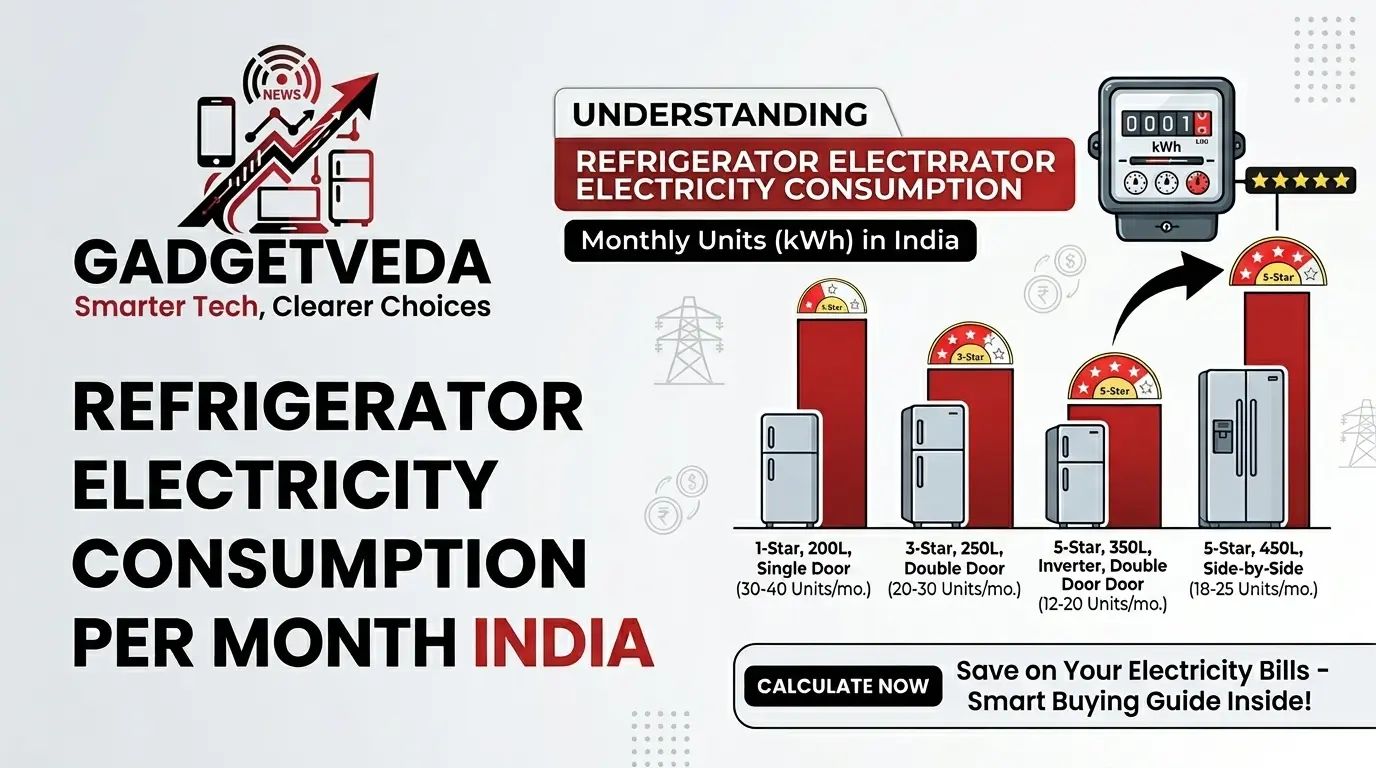
Your refrigerator is the only appliance in your home that never gets a day off. While fans and air conditioners run for a few months and are switched off at night, your fridge runs 24 hours a day, 365 days a year — quietly adding units to your electricity bill every single hour. Yet most Indian households have no clear idea how much their refrigerator actually costs to run each month.
The answer isn’t just one number. Refrigerator electricity consumption per month in India depends on your fridge’s capacity, its BEE star rating, whether it has an inverter compressor, how old it is, your daily usage habits, and even the ambient temperature of your kitchen. In this guide, we break it all down — from a simple step-by-step calculation method to a ready-to-use reference table, real-world monthly cost estimates across different fridge sizes, and practical tips to cut your fridge’s electricity bill without compromising food freshness.
🔍 Also Explore: Best Refrigerators in India by Budget
Once you know your ideal capacity and star rating, finding the right model is easy. Browse our curated picks across every budget:
❄️ Best Refrigerators Under ₹10,000 in India—Compact single-door direct-cool options; ideal for bachelors, hostel rooms, and small kitchens
🧊 Best Refrigerators Under ₹12,000 in India—Entry-level single-door fridges from trusted brands with basic star ratings and reliable cooling
🌟 Best Refrigerators Under ₹15,000 in India— Single-door and select small double-door models; strong value for couples and small families
⚡ Best Refrigerators Under ₹18,000 in India—Mid-range direct-cool and frost-free options; better star ratings and bigger capacities start here
🏆 Best Refrigerators Under ₹20,000 in India— Our most popular tier; solid double-door frost-free fridges with inverter compressors for families of 3–4
🔝 Best Refrigerators Under ₹25,000 in India—Premium double-door and multi-door options with high BEE star ratings, larger capacities, and advanced features for bigger families
Why Your Refrigerator Uses More Electricity Than You Think
Most people assume the fridge is a minor contributor to their electricity bill because it runs quietly in the background and doesn’t visibly heat up the room the way a geyser or AC does. That assumption is wrong.
A typical double-door frost-free refrigerator draws around 150–300 watts of rated power. A single-door fridge in the 165–200 liter range — common in smaller Indian households — typically draws 80–130 watts rated, while larger frost-free double-door models in the 300–400 liter range can comfortably exceed 200 watts. Because the fridge never switches off entirely, this wattage compounds into significant monthly consumption over 720 hours of continuous operation.
One critical nuance to understand: fridges don’t run at full rated wattage all the time. The compressor cycles on and off based on the internal cooling demand and the ambient temperature around it. For a modern, well-functioning refrigerator under typical Indian household conditions, the compressor runs roughly 30–70% of the total time — a range referred to as the duty cycle. Under moderate ambient conditions, many standard fridges target around a 50% duty cycle, though older fixed-speed compressor units often run closer to 60–70% in hot Indian kitchens. This means the actual energy drawn in practice is considerably lower than what you’d calculate using rated wattage alone — a distinction that matters significantly when estimating your monthly electricity bill.
How to Calculate Your Refrigerator’s Electricity Consumption
Here’s the step-by-step method to calculate your fridge’s monthly energy use — no engineering degree required:
📐 Step 1: Find the rated wattage
Check the BEE energy label on your fridge (usually inside the door or on the back panel), or look at the product manual or the Amazon/Flipkart listing for the wattage specification.
⚙️ Step 2: Apply the duty cycle
Since the compressor doesn’t run continuously, multiply the rated wattage by 0.40–0.55 (a 40–55% duty cycle for a standard fixed-speed compressor in Indian ambient conditions) to estimate effective running wattage.
🔢 Step 3: Calculate monthly units (kWh)
You can use this formula to calculate the monthly units consumed by your refrigerator:
Monthly units = (Effective wattage × 24 hours × 30 days) ÷ 1000
💰 Step 4: Multiply by your electricity tariff
India’s national residential average tariff is approximately ₹7–8 per unit (kWh) in 2026, but this varies significantly by state and consumption slab — from around ₹3/unit in lower slabs in Delhi to ₹10+/unit in higher slabs in Maharashtra. Use your actual per-unit rate from your electricity bill for the most accurate cost estimate.
Worked example — 250L double-door frost-free fridge, 3-star:
➤ Rated wattage: ~150W → Effective wattage at 50% duty cycle: 75W
➤ Monthly units: (75 × 24 × 30) ÷ 1000 = 54 units/month
➤ Monthly cost at ₹7.5/unit: 54 × 7.5 = ₹405/month
💡 Pro tip —use the BEE label directly: The most accurate method is to check the annual kWh figure printed on your fridge’s BEE star label and divide by 12 to get your monthly consumption. This bypasses all duty-cycle guesswork and gives you manufacturer-tested data. A 250L 3-star frost-free fridge typically shows around 400–500 kWh/year on its BEE label, which works out to approximately 33–42 units/month and up to 54 units/month.
Refrigerator Electricity Consumption Per Month Reference Table
This table covers the most common fridge types and sizes sold in Indian homes, with approximate monthly units based on standard duty cycle assumptions and indicative monthly costs at ₹7.5/unit:
| Fridge Type | Capacity | Approx. Effective Wattage | Est. Monthly Units | Est. Monthly Cost (₹7.5/unit) |
| Single door (direct cool) | 150–180L | 35–55W effective | 25–40 units | ₹188–₹300 |
| Single door (direct cool) | 190–220L | 45–65W effective | 32–47 units | ₹240–₹353 |
| Double door (frost-free) | 230–270L | 55–80W effective | 40–58 units | ₹300–₹435 |
| Double door (frost-free) | 280–330L | 70–100W effective | 50–72 units | ₹375–₹540 |
| Double door (frost-free) | 340–400L | 90–130W effective | 65–94 units | ₹488–₹705 |
| Side-by-side / French door | 500–650L | 130–200W+ effective | 94–144+ units | ₹705–₹1,080+ |
ℹ️ Estimates based on a 45–55% compressor duty cycle and ₹7.5/unit tariff. Actual values vary with BEE star rating, inverter vs non-inverter compressor, usage habits, ambient temperature, and door-opening frequency. Always cross-check with the annual kWh on the BEE label for most accurate single or double door fridge electricity consumption.
How BEE Star Rating Affects Monthly Electricity Consumption
The BEE (Bureau of Energy Efficiency) star label on Indian refrigerators is one of the most important factors influencing how much your fridge costs to run — and one of the most underappreciated at the point of purchase.
A higher star rating means the fridge achieves better energy efficiency for the same cooling output, based on standardized test conditions. Critically, BEE calculates separate efficiency thresholds for direct-cool and frost-free refrigerators, accounting for the different volumes of fresh-food and freezer compartments using a weighted formula. The annual energy consumption figure printed on the BEE label is the single most reliable number to compare refrigerators when shopping — far more useful than rated wattage alone.
Here’s how the star ratings translate to approximate consumption for a 250L frost-free double-door fridge — one of the most common configurations in Indian mid-size homes:
| BEE Star Rating | Annual kWh (approx. 250L frost-free) | Monthly Units | Monthly Cost (₹7.5/unit) | Savings vs 1-Star |
| ⭐ 1 Star | ~550–650 kWh/year | 46–54 units | ₹345–₹405 | Baseline |
| ⭐⭐ 2 Star | ~470–550 kWh/year | 39–46 units | ₹293–₹345 | ~15–20% |
| ⭐⭐⭐ 3 Star | ~400–470 kWh/year | 33–39 units | ₹248–₹293 | ~25–30% |
| ⭐⭐⭐⭐ 4 Star | ~340–400 kWh/year | 28–33 units | ₹210–₹248 | ~35–40% |
| ⭐⭐⭐⭐⭐ 5 Star | Below ~340 kWh/year | Under 28 units | Under ₹210 | ~45–55% |
Over a 10-year ownership period, the electricity cost difference between a 1-star and 5-star fridge of similar capacity can amount to ₹15,000–₹25,000 — a compelling reason to stretch slightly on the upfront purchase price.
Inverter Compressor vs Non-Inverter: Does It Really Save Electricity?
This is one of the most searched questions among Indian refrigerator buyers — and the answer is a clear yes, with some important context.
A non-inverter (conventional) compressor operates at a fixed speed: it’s either fully on or fully off. This binary cycle causes frequent start-ups, which is when the highest current draw occurs, and results in slight temperature fluctuations inside the fridge.
An inverter compressor operates at variable speeds — running faster when more cooling is needed and slowing down to a low continuous speed once the target temperature is reached. This eliminates the energy spikes from frequent start-stop cycles and maintains more stable internal temperatures. The practical benefits for Indian consumers:
➤ 10–25% lower electricity consumption over the year compared to a non-inverter model of equivalent star rating
➤ Quieter operation — the compressor hums at low speed instead of cycling loudly on and off
➤ Longer compressor life — fewer start-stop stress cycles mean less mechanical wear
➤ Better performance in Indian summer conditions — inverter compressors adjust dynamically to rising ambient kitchen temperatures instead of struggling with binary on-off cycling.
In practical terms, if you are choosing between a 3-star non-inverter and a 3-star inverter fridge at a similar price point, the inverter model will almost always deliver lower monthly bills and better long-term reliability. When comparing across brands, always check both the BEE star rating and whether the model carries an inverter compressor.
Factors That Silently Increase Your Fridge’s Electricity Consumption
Beyond star ratings and compressor type, several daily habits and environmental factors quietly push up your refrigerator’s electricity consumption per month:
🌡️ High ambient kitchen temperature — Indian kitchens in summer can easily reach 35–42°C. The hotter the kitchen, the harder the compressor works to maintain internal temperature, directly increasing run time and power draw.
🚪 Frequent door opening — Every time the door opens, cold air escapes, and the compressor needs extra cycles to recover. This is especially significant in large families with multiple people accessing the fridge throughout the day.
🍲 Storing hot food directly — Hot food raises the internal temperature sharply, forcing the compressor to work harder. Always let food cool to near room temperature before placing it inside.
📦 Overpacking or underpacking — A completely overfilled fridge restricts internal air circulation, reducing cooling efficiency. A nearly empty fridge loses cold air faster with each door opening. A moderately stocked fridge is most efficient.
🧊 Frost buildup in older direct-cool fridges — Excess frost on freezer walls acts as an insulating barrier that the compressor has to overcome. Regular manual defrosting restores efficiency meaningfully in older single-door models.
🔌 Poor rear ventilation — Fridges need adequate clearance (typically at least 5–10 cm) behind and on the sides for condenser coils to dissipate heat. Placing a fridge in a tight cabinet or flush against a wall measurably increases compressor run time and energy use.
Old Fridge vs New Fridge: The Real Electricity Cost Gap
Many Indian families hold on to a 10–15-year-old single-door fridge simply because it “still works.” But age significantly erodes refrigerator efficiency in ways that add up quietly on every monthly bill.
Older refrigerators — particularly those manufactured before BEE star norms were significantly tightened — can consume 40–80% more energy than a modern equivalent of the same capacity. Degraded door seals, worn compressor valves, accumulated condenser dust, and older refrigerant blends (like R-134a in pre-2018 models vs. more efficient R-600a/R-290 in newer ones) all contribute to this growing efficiency gap.
Payback period calculation — a practical framework:
➤ Note the annual kWh from your current fridge’s BEE label (or estimate from its contribution to your electricity bill).
➤ Compare with the annual kWh of a new equivalent-capacity 4 or 5-star model.
➤ Multiply annual unit savings by your per-unit tariff to get yearly savings.
➤ Divide the purchase price premium of the new fridge by annual savings to get your payback period in years.
In many realistic Indian scenarios, replacing a pre-2015 single-door fridge with a modern 5-star inverter model pays back the price difference in electricity savings within 4–7 years, with continued savings over the remainder of a 12–15 year appliance life.
Tips to Reduce Your Fridge’s Monthly Electricity Bill
You don’t need a new fridge to start reducing consumption today. These habits make a measurable difference:
✅ Set the right temperature — 3–5°C for the refrigerator compartment and -15 to -18°C for the freezer is sufficient for food safety while avoiding unnecessary overcooling.
✅ Clean condenser coils regularly — Vacuum or brush dust off the coils at the back or bottom of the fridge every 3–4 months. Dusty coils reduce heat dissipation and force the compressor to work longer.
✅ Check door seals every 6 months — A worn or loose door gasket continuously leaks cold air. Test by closing the door on a sheet of paper — if it slides out easily, the gasket needs cleaning or replacement.
✅ Don’t place the fridge near heat sources — Keep it away from direct sunlight, the gas stove, and walls without ventilation. Even reducing ambient temperature by a few degrees measurably lowers compressor run time.
✅ Keep the fridge moderately stocked — Not sparse (loses cold air fast per door opening) and not crammed (restricts internal air circulation). A moderately filled fridge with organized, breathable shelving is optimal.
✅ Cool food before storing — This single habit prevents sharp internal temperature spikes and saves meaningful compressor run time over the course of weeks.
✅ Defrost older direct-cool fridges regularly — If you have a non-frost-free model, defrost as soon as ice buildup visibly thickens (typically every 2–4 weeks in summer) to maintain compressor efficiency.
Conclusion
Your refrigerator is a silent but consistent driver of your monthly electricity bill — and understanding its consumption puts you in control of a cost that never takes a break. For most Indian households, a single-door direct-cool fridge consumes roughly 25–47 units per month, while a double-door frost-free model typically draws 40–94 units per month, depending on capacity, star rating, compressor type, and usage habits. At 2026 Indian tariff rates, that translates to approximately ₹188–₹705 per month for most domestic refrigerators — a number that, with the right habits and a well-chosen upgrade, can be meaningfully reduced over time.
At GadgetVeda, we help you make smarter, cost-conscious appliance decisions. If you’re considering upgrading your refrigerator, check out our curated guides across budget ranges for the most energy-efficient refrigerators in India right now — ranked by real-world performance, BEE star ratings, and long-term value.



![12 Best Earbuds Under ₹3,000 in India [2026] | GadgetVeda](https://gadgetveda.com/wp-content/uploads/2026/09/Best-Earbuds-Under-₹3000-in-India-150x150.webp)
![11 Best Washing Machines Under ₹50,000 in India [2026]](https://gadgetveda.com/wp-content/uploads/2026/09/Best-Washing-Machines-Under-₹50000-in-India-150x150.webp)
![14 Best Wireless Earbuds Under ₹2,000 in India [2026]](https://gadgetveda.com/wp-content/uploads/2026/09/Best-Wireless-Earbuds-Under-₹2000-in-India-150x150.webp)
![10 Best Wireless Earbuds Under ₹1,000 in India [2026]](https://gadgetveda.com/wp-content/uploads/2026/09/Best-Wireless-Earbuds-Under-₹1000-in-India-150x150.webp)


![12 Best Earbuds Under ₹3,000 in India [2026] | GadgetVeda](https://gadgetveda.com/wp-content/uploads/2026/09/Best-Earbuds-Under-₹3000-in-India-300x167.webp)
![11 Best Washing Machines Under ₹50,000 in India [2026]](https://gadgetveda.com/wp-content/uploads/2026/09/Best-Washing-Machines-Under-₹50000-in-India-300x167.webp)
![14 Best Wireless Earbuds Under ₹2,000 in India [2026]](https://gadgetveda.com/wp-content/uploads/2026/09/Best-Wireless-Earbuds-Under-₹2000-in-India-300x167.webp)
![10 Best Wireless Earbuds Under ₹1,000 in India [2026]](https://gadgetveda.com/wp-content/uploads/2026/09/Best-Wireless-Earbuds-Under-₹1000-in-India-300x167.webp)