


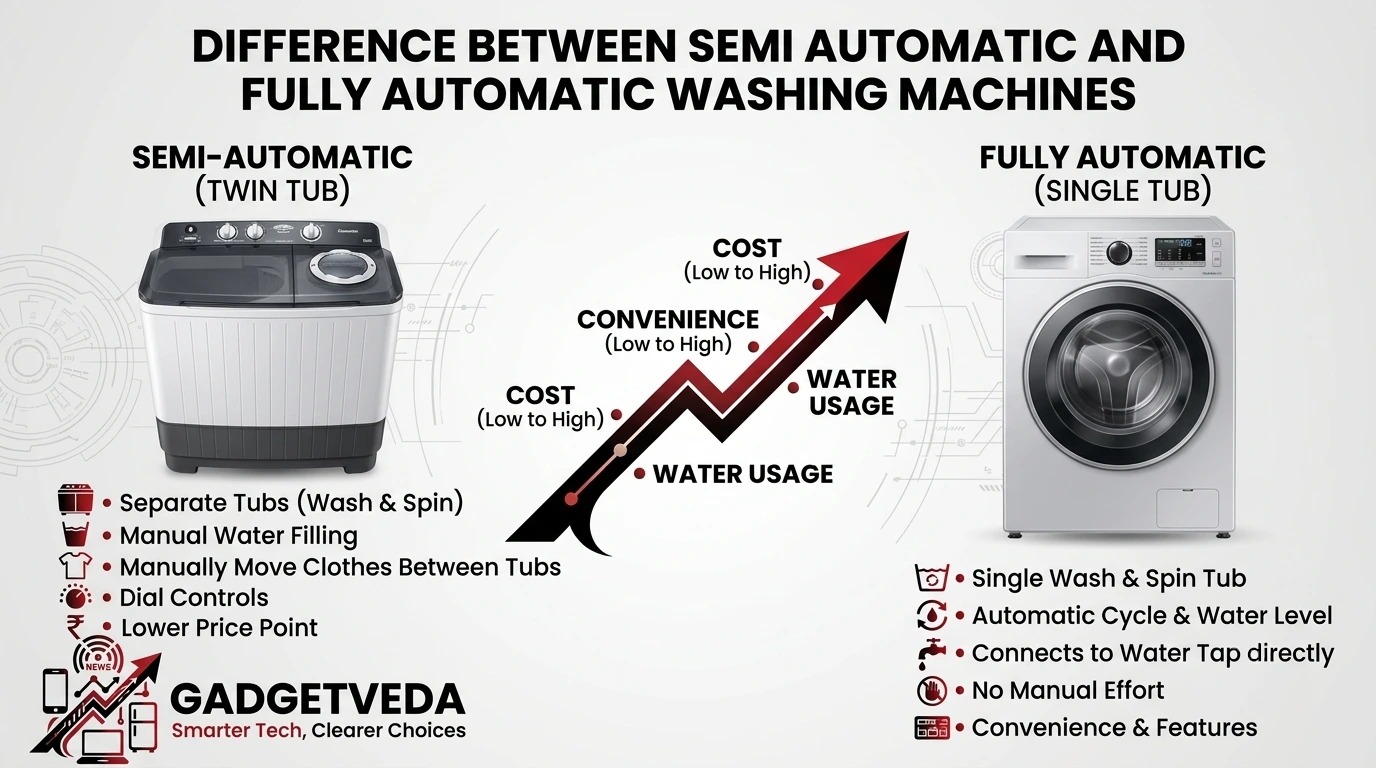
The difference between semi automatic and fully automatic washing machine comes down to who does the work. A semi-automatic needs you to fill water and move clothes between tubs. A fully automatic handles fill, wash, rinse and spin by itself. Price, water use, electricity, fabric care and daily effort all follow from that one split.
At GadgetVeda, this is one of the most common questions we get from first-time buyers. Most of them are comparing a ₹10,000 machine with a ₹25,000 one and can’t tell what the extra money buys. This guide explains how each type works, compares them point by point, and tells you which household suits which machine.
How a Semi-Automatic Washing Machine Works
A semi-automatic has two separate tubs side by side. One is the wash tub, with a pulsator at the base. The other is the spin tub, which dries clothes by centrifugal force.
You fill the wash tub by hand or with a hose and add detergent. You set a wash timer, then lift the clothes into the spin tub yourself. Draining and refilling for the rinse are also manual steps. Because you control the water and the timing, you stay involved for most of the cycle.
The strengths are simple. Semi-automatics cost less, have fewer electronic parts, and work in homes with low water pressure or an irregular supply, because they don’t need a continuous tap connection. The weakness is time. Someone has to be around to move loads and refill water.
How a Fully Automatic Washing Machine Works
A fully automatic uses one drum for everything. You load the clothes, add detergent, pick a programme and press start. The machine fills water, washes, rinses, drains and spins without you. There are two designs.
🚀 Top-load fully automatic: Clothes go in from the top. An agitator or impeller moves them through the water. These machines are generally priced in the middle, and you can add a forgotten sock mid-cycle on many models.
⚡ Front-load fully automatic: Clothes go in through a door at the front of a horizontal drum, where they tumble. This usually means gentler fabric care and stronger stain removal, and it typically costs more.
Difference Between Semi Automatic and Fully Automatic Washing Machine at a Glance
| Factor | Semi-Automatic | Fully Automatic Top Load | Fully Automatic Front Load |
| Tubs | Two (wash + spin) | One | One |
| Manual Effort | High (transfer, refill) | Minimal | Minimal |
| Water Connection | Not essential | Needed | Needed |
| Programmes | Basic timers | Multiple | Widest fabric-care options |
| Upfront Price | Lowest | Mid-range | Generally highest |
| Water Control | Manual | Sensor-based | Sensor-based |
| Best For | Tight budgets, irregular water | Busy families | Quality-conscious buyers |
Semi Automatic vs Fully Automatic Washing Machine: Water Use
Many buyers assume a fully automatic must use more water. The official numbers say otherwise, and they depend on the design.
Water use declared under BEE ratings for representative models shows a clear pattern. A semi-automatic uses about 17 litres per kg of clothes per cycle. A top-load fully automatic uses about the same, roughly 17 litres per kg. A front-load fully automatic uses only about 7 litres per kg. These are figures for individual models, not an industry average, but the pattern holds: a front-loader is the clear water saver, while a semi-automatic and a top-loader come out close.
Semi-automatics have a practical edge here, because you decide exactly how much water goes in. Many owners reuse the soapy water for floors or heavily soiled items. In water-scarce homes, that control matters as much as the rated figure.
Electricity Consumption Compared
A semi-automatic is generally the lighter user of electricity. It has no heater, no electronic control board and no sensors. As a rough guide, the wash motor draws about 350–450W and the spin motor about 150W. That puts a 45-minute wash-and-spin session at around 0.3 kWh.
Fully automatics draw more because of their electronics, bigger motors, and heating on models that have a heater. Hot-water programmes account for most of the extra power. Even so, the monthly gap for an average Indian family is usually small. Check the BEE star rating on the model you’re considering rather than assuming, since consumption varies a lot by capacity and programme.
Price, Maintenance and Durability
💰 Upfront price: Semi-automatics are generally the cheapest, and front-loaders the costliest.
⚙️ Repairs: A semi-automatic has simpler mechanics and fewer parts that can fail, so repairs are usually quick and cheap. A fully automatic has a control board, door lock, pressure sensor and inlet valve. These are reliable when looked after, but they cost more to replace.
🧊 Hard water: If your area has high TDS, scale builds up faster in fully automatics, especially around the heater and sensors. Our guide on hard water washing machine care in India covers that in detail.
🛡️ Space: Semi-automatics are wider because of the twin tubs. Fully automatics take up less floor area but need a water point and a drain.
Fabric Care and Wash Quality
A semi-automatic pulsator is tough on fabric. It cleans heavily soiled cotton, school uniforms and work clothes well, but it can be harsh on delicates. You also have to judge wash time yourself.
A fully automatic top-loader offers more programmes and softer handling. A front-loader tumbles clothes rather than agitating them, which usually gives gentler care and better stain removal. If you own silk, woollens or expensive garments, this is where the extra spend pays off.
Which One Should You Buy?
Choose semi-automatic if:
✅ Your budget is tight and every rupee counts.
✅ Your water supply is irregular or the pressure is low.
✅ You don’t mind staying nearby during a wash.
✅ You mostly wash sturdy everyday cotton.
Choose fully automatic top load if:
✅ Both partners work and time is short.
✅ You want a balance of price, convenience and programmes.
✅ You have a steady water connection.
Choose fully automatic front load if:
✅ You want the best water efficiency and fabric care.
✅ Your budget is higher and you wash delicates regularly.
✅ You can place the machine on a firm, level floor.
What Indian Buyers Are Actually Choosing
The market is moving toward fully automatics. A decade ago, semi-automatics held roughly 59% of Indian sales, with top-loaders at about 29% and front-loaders at about 12%. Over the following years, top-load rose to around 52% and front-load to about 19%, while semi-automatics fell to roughly 30%. Overall washing machine ownership in India is still low, at around 16% of households in the data we reviewed.
Current industry estimates put fully automatics at roughly 55% to 64% of the 2025 market, depending on how each analyst measures it. The exact number varies, but every estimate we checked puts fully automatics ahead. Semi-automatics remain strong in rural and semi-urban areas, where price sensitivity is highest.
Explore Our Washing Machine Picks by Budget
Once you’ve picked a type, shortlist models with our budget-wise guides:
👉 Best Washing Machines Under ₹10,000: Best for semi-automatic buyers and first-time users
👉 Best Washing Machines Under ₹15,000: Best for small families moving up to fully automatic
👉 Best Washing Machines Under ₹20,000: Best for top-load fully automatics with more programmes
👉 Best Washing Machines Under ₹25,000: Best for feature-rich top-loaders and entry-level front-loaders
Mistakes to Avoid Before You Buy
➡️ Ignoring your water supply. A fully automatic needs a steady tap or tank feed.
➡️ Buying too small. Pick capacity by household size, not just by price.
➡️ Skipping the star rating. It affects your electricity bill for years.
➡️ Forgetting installation space. Measure the spot, including door or lid clearance.
➡️ Choosing by brand alone. Check service availability in your city first.
Conclusion
The difference between semi automatic and fully automatic washing machine is effort, control and cost. A semi-automatic suits tight budgets and unreliable water. A fully automatic suits busy households that value time and gentler fabric care. Match the machine to your water supply, budget and routine, not to the brand name.
At GadgetVeda, we keep our guides practical so you can buy once and buy right. Use the budget links above to shortlist models for your price range.
FAQs
1. What is the difference between semi automatic and fully automatic washing machine?
A semi-automatic has separate wash and spin tubs and needs you to move clothes and manage water. A fully automatic does everything inside one drum with no manual steps.
2. Which uses less water, semi automatic or fully automatic washing machine?
A front-load fully automatic uses the least, at about 7 litres per kg per cycle under BEE-declared figures. A semi-automatic and a top-load fully automatic come out close to each other at about 17 litres per kg per cycle.
3. Does a semi-automatic save electricity?
Generally yes. It has no heater or control board, and a 45-minute session uses around 0.3 kWh. Actual use depends on model and load.
4. Can a fully automatic work without a continuous water supply?
Most need a connected tap or a tank at suitable height. If your supply is erratic, a semi-automatic is the safer choice.
5. Which lasts longer, semi automatic or fully automatic washing machine?
Semi-automatics have simpler parts and cheaper repairs. A well-maintained fully automatic also lasts many years, but its electronics cost more to fix. Good installation and regular cleaning matter more than type.



![OnePlus Nord Buds 4 Review [Price, ANC & Battery Verdict]](https://gadgetveda.com/wp-content/uploads/2026/10/OnePlus-Nord-Buds-4-Review-GadgetVeda-150x150.webp)

![5 Best Smart TVs Under ₹15,000 in India [2026]](https://gadgetveda.com/wp-content/uploads/2026/10/Best-Smart-TVs-Under-₹15000-in-India-150x150.webp)

![OnePlus Nord Buds 4 Review [Price, ANC & Battery Verdict]](https://gadgetveda.com/wp-content/uploads/2026/10/OnePlus-Nord-Buds-4-Review-GadgetVeda-300x167.webp)
![5 Best Smart TVs Under ₹15,000 in India [2026]](https://gadgetveda.com/wp-content/uploads/2026/10/Best-Smart-TVs-Under-₹15000-in-India-300x167.webp)