


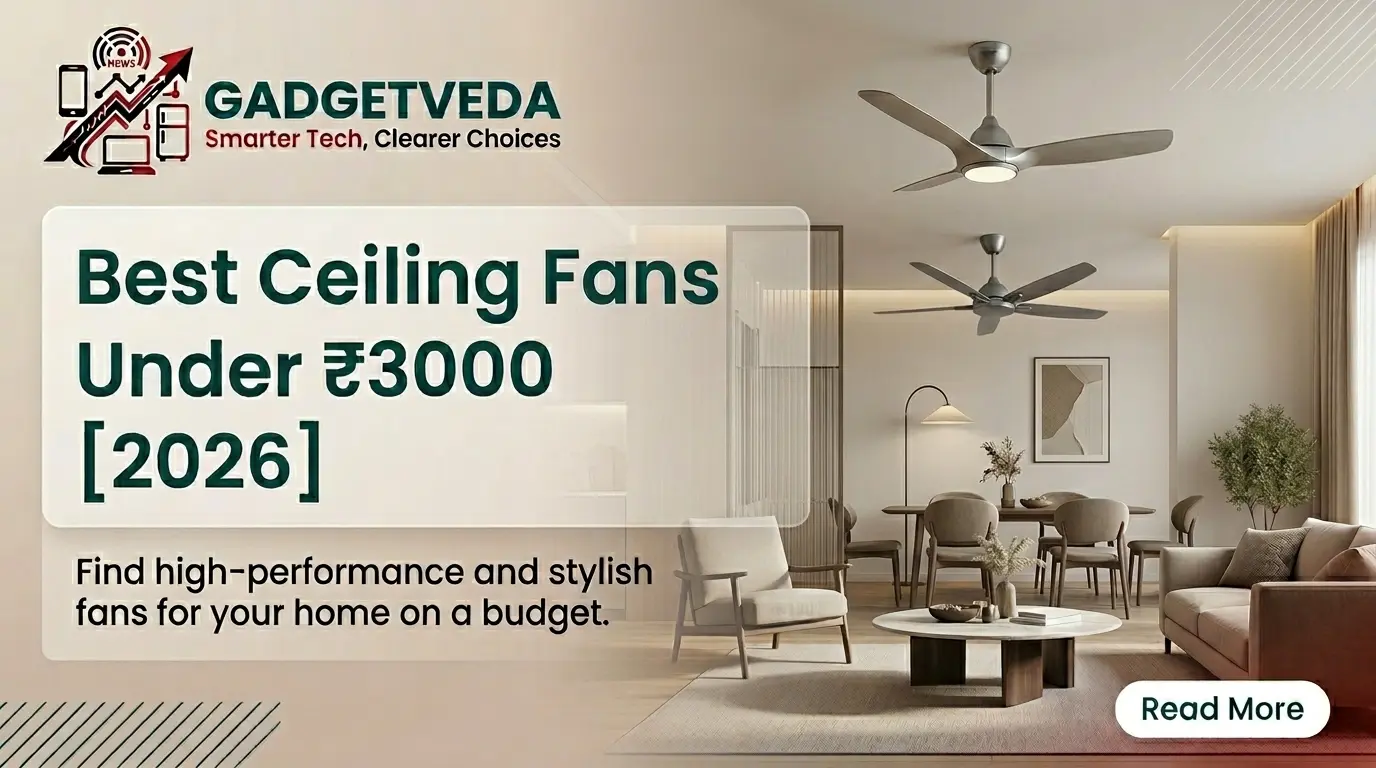
Every summer, millions of Indian households ask the same question: Is the fan above me doing its job, or is it just moving hot air in circles? At 45°C, that question stops being casual. The best ceiling fans under 3000 in 2026 are no longer just spinning blades — they are precision air-movement machines that compete on BLDC motor efficiency, real-world CMM airflow, acoustic discipline, and voltage resilience. Rising electricity tariffs and relentless heatwaves have pushed buyers to demand a lot more from this budget: BEE 5-star ratings, stabilizer-free operation through voltage swings between 120 V and 285 V, remote control with sleep and timer modes, and blades that stay cleaner and balanced despite the fine particulate pollution coating every open surface in Indian cities.
At GadgetVeda, every ceiling fan under 3000 is evaluated like a miniature HVAC unit rather than a commodity product. RPM figures are meaningless unless they translate to real CMM (Cubic Meters per Minute) airflow inside typical Indian rooms, so every model is assessed on how 350–400 RPM interacts with blade pitch, sweep size, and motor torque under a 12-hour daily load. GadgetVeda’s testing methodology also tracks motor heat rise after long use, bearing hum in quiet bedrooms, BLDC driver stability on fluctuating supply voltage, and how quickly dust, kitchen grease, and fine road pollution adhere to blade surfaces and motor housings over weeks of continuous running — because longevity matters as much as first-week performance.
📌 Also on GadgetVeda: Explore our curated guides to the best ceiling fans under ₹2,000 for value-first picks, the best ceiling fans under ₹1,500 for the tightest budgets, and the best ceiling fans under ₹1000 in India for ultra-compact or utility-space choices — so you can plan the right fan for every room in your home.
Best Ceiling Fans Under ₹3,000 [Quick Comparison]
| Rank | Model Name | Key Specifications | Expert Rating | Check Price |
|---|---|---|---|---|
| 1 | Atomberg Efficio Alpha 1200 mm BLDC | 1200 mm; BLDC 5-star; 365 RPM; 230 CMM; 28 W; Smart IR remote; LED indicator; 165–285 V stable | 9.4/10 | Check on Amazon |
| 2 | Crompton Energion Caelum 1200 mm BLDC | 1200 mm; ActivBLDC 5-star; 350 RPM; 220 CMM; 28 W; dual remote + regulator control; aluminium anti-rust blades; 4-year motor warranty | 9.2/10 | Check on Amazon |
| 3 | Orient Electric Zeno 1200 mm BLDC | 1200 mm; BLDC 5-star; 350 RPM; 220 CMM; 32 W; smart remote with boost & timer; 120–280 V; saves up to 50% energy | 9.1/10 | Check on Amazon |
| 4 | Crompton Energion Nucleoid 1200 mm BLDC | 1200 mm; ActivBLDC 5-star; 340 RPM; 220 CMM; 24 W; premium remote with Hyper mode; 2H–8H timer; aluminium anti-rust blades; 4-year motor warranty | 9.0/10 | Check on Amazon |
| 5 | Colorbot Stella 1200 mm BLDC | 1200 mm; BLDC 5-star; 370 RPM; 220 CMM; 26 W; 6-speed remote; reverse mode; 100% copper winding; sealed double ball bearing; 2+2 year warranty | 9.0/10 | Check on Amazon |
| 6 | V-Guard Windle Deco BLDC 1200 mm | 1200 mm; BLDC 5-star; 380 RPM; 222 CMM; 34 W; RF remote; 4 wind modes (Sleep, Breeze, Boost, Reverse); 8-hour timer; 2-year warranty | 8.9/10 | Check on Amazon |
| 7 | Polycab Wizzy Plus LED 1200 mm BLDC | 1200 mm; BLDC 5-star; ~225 CMM; ~35 W; 7-speed control + Boost; Fine Speed (25 micro-steps); reverse & breeze modes; LED speed indicator | 8.9/10 | Check on Amazon |
| 8 | Polycab Aereo Purocoat 1200 mm | 1200 mm; high-speed induction; 400–440 RPM; 230 CMM; 75 W; Nanova anti-dust/anti-rust coating; double ball bearing; 99.99% copper winding | 8.7/10 | Check on Amazon |
8 Best Ceiling Fans Under ₹3,000 in India [Detailed Reviews]
1. Atomberg Efficio Alpha 1200 mm BLDC — Classic All-Rounder With Elite Efficiency

⚡ 28 W BLDC efficiency; BEE 5-star rated; saves substantially over older 75 W induction fans; inverter-friendly performance.
🌬️ 230 CMM airflow at 365 RPM; 1200 mm sweep; strong full-room cooling for typical Indian bedrooms and medium living spaces.
🎛️ Smart IR remote + voltage stability; boost, sleep, and timer modes; stable operation across 165–285 V for Indian grid fluctuations.
If your top-floor, west-facing bedroom turns into a concrete furnace from 3 pm onwards, the Atomberg Efficio Alpha is the kind of ceiling fan that changes how you think about an electricity bill. This 1200 mm BLDC ceiling fan pushes 230 CMM of air at 365 RPM while consuming just 28 W at top speed, backed by a BEE 5-star rating and a quietly dominant reputation among performance-focused buyers. For a 130–150 sq. ft. bedroom, that airflow means no hot-air pockets in the corners while the person directly under the fan hogs all the breeze.
Beyond headline numbers, Atomberg’s blade aerodynamics and motor control are tuned for Indian grid realities, making it one of the best ceiling fans under 3000 for Indian homes. Powder-coated blades with a low-drag profile keep the fan quieter at mid speeds, while the motor delivers consistent rotation between 165–285 V — so you avoid the miserable “fan is spinning, but air feels weak” feeling during summer peak-load hours. The smart IR remote includes boost, timer, and sleep modes, covering every comfort scenario from peak-afternoon cooling to slow-fade-to-silence at midnight.
Running the numbers makes the BLDC argument impossible to ignore. At 28 W versus a typical 75 W induction fan, with 12 hours of daily use, a single Efficio Alpha saves roughly 17 units per month — around ₹135 at ₹8 per unit. Over two heavy-use summers, the fan quietly pays back any price premium over a basic induction model without requiring you to adjust a single setting.
Pros
✅ 230 CMM airflow and 365 RPM deliver strong, room-wide cooling on a 1200 mm sweep
✅ 28 W BLDC motor saves up to ~65% power compared to older 75 W induction fans
✅ Smart IR remote with boost, timer, and sleep modes — no pairing hassles
✅ Runs 3× longer on inverter; stable speed across the 165–285 V range
Cons
❌ Remote is IR, not RF — requires line-of-sight and correct pointing angle
❌ Glossy finish accumulates fingerprints and oily dust faster than matte alternatives
👉 Check Atomberg Efficio Alpha 1200 mm Latest Price on Amazon
2. Crompton Energion Caelum 1200 mm BLDC — Dual-Control Workhorse for Mixed-Use Rooms
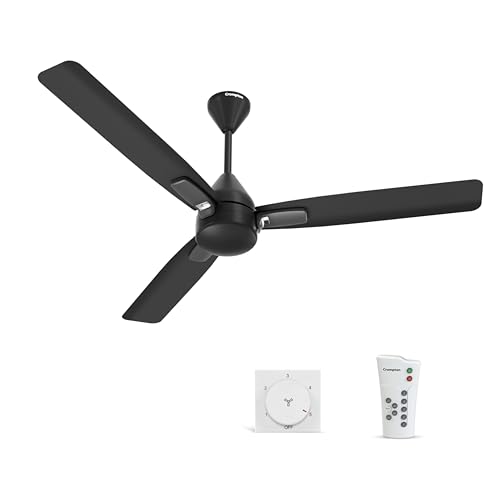
⚡ 28 W ActivBLDC motor; BEE 5-star efficiency; lower running cost than conventional 75 W fans; built for heavy summer use.
🌬️ 220 CMM air delivery at 350 RPM; 1200 mm sweep; balanced airflow for bedrooms, WFH rooms, and mixed-use family spaces.
🎛️ Dual-control convenience; remote + regulator compatibility via Regmote; powder-coated aluminum anti-rust blades for durability.
Families using the same space as a WFH office by day and a TV lounge by night will appreciate how the Crompton Energion Caelum balances high-efficiency BLDC performance with old-school regulator familiarity. Rated at 5 stars, this 1200 mm fan uses ActivBLDC technology to deliver 220 CMM at 350 RPM while drawing only 28 W, and uniquely permits both remote and wall-regulator control to coexist through Crompton’s “Regmote” system.
Aerodynamically, the Caelum relies on powder-coated aluminum anti-rust blades that are slim yet stiff — maintaining stable, wobble-free rotation at speed without the flex or creak that cheaper sheet-metal blades sometimes exhibit after a season of use. The double ball-bearing BLDC assembly keeps bearing noise low even when the fan runs continuously through peak summer nights, which is non-negotiable in homes where the fan rarely switches off between April and July.
Financially, this BLDC ceiling fan under 3000 from Caelum sits in the same efficiency band as Atomberg’s flagship. At 28 W for 12 hours daily, monthly consumption is roughly 10 units versus about 27 units for a 75 W induction fan — saving approximately 17 units a month, or ~₹135 at ₹8 per unit. Across a household with three such fans, the annual savings easily cross a four-digit figure that no legacy high-speed induction fan can replicate.
Pros
✅ 220 CMM airflow and 350 RPM give strong, controlled circulation for a 1200 mm sweep
✅ ~60% lower consumption than old 75 W induction fans with BEE 5-star certification
✅ “Remote” dual control: works with both the included remote and a standard wall regulator
✅ Aluminum anti-rust, powder-coated blades for better durability in humid or dusty homes
Cons
❌ The regulator is not included in the box; some buyers may need to upgrade their existing wall unit.
❌ Plastic-heavy remote feels less premium than the motor and blade engineering deserve
👉 Check Crompton Energion Caelum 1200 mm Latest Price on Amazon
3. Orient Electric Zeno 1200 mm BLDC — Inverter-Friendly Silence for Power-Cut-Prone Areas

⚡ 32 W BLDC motor; BEE 5-star rated; up to 50% energy saving claim; runs efficiently during long daily summer cycles.
🌬️ 220 CMM airflow at 350 RPM; 1200 mm sweep; dependable cooling for study rooms, bedrooms, and power-cut-prone homes.
🎛️ Smart remote + wide voltage range; boost and timer modes; smooth performance from 120–280 V for inverter-friendly use.
Students preparing for late-night exams in power-cut-prone towns need a fan that keeps pace with their concentration, not one that sags in speed when the inverter kicks in. The Orient Electric Zeno BLDC is engineered precisely for that scenario — a 5-star fan with a 1200 mm sweep, 350 RPM, and 220 CMM air delivery that consumes just 32 W while remaining rated to run smoothly between 120–280 V.
Operational resilience is where this model earns its place. The wide voltage tolerance prevents the choppy, stuttering speed changes that occur when the city supply dips unexpectedly — crucial for uninterrupted sleep or focused study. The remote offers timer options (2/4/6/8 hours), boost mode for immediate maximum airflow, and an ON/OFF range up to 15 feet, allowing users to run the fan hard in the evening and taper automatically as the room cools without touching a switch.
From a savings standpoint, for this ceiling fan under 3000, 32 W at 12 hours daily equals roughly 11.5 units monthly versus 27 units for a 75 W induction fan — saving about 15.5 units each month. Over an eight-month intense summer and shoulder season, that adds up to more than 120 units saved per fan, or approximately ₹960 a year at ₹8 per unit. For an inverter-compatible ceiling fan under ₹3000, that trade-off between price, airflow, and backup efficiency is genuinely compelling.
Pros
✅ 220 CMM and 350 RPM provide excellent coverage for 65–120 sq. ft. rooms
✅ 32 W BLDC motor saves about 50% power and runs 2× longer on the inverter vs induction
✅ Smart remote with timer and boost — ideal for sleep and late-night study routines
✅ Wide 120–280 V operating range for consistent speed during voltage fluctuations
Cons
❌ Slightly higher wattage than the most frugal 24–28 W BLDC rivals in this guide
❌ Plain design offers less visual personality compared to dual-tone or decorative alternatives.
👉 Check Orient Electric Zeno 1200 mm Latest Price on Amazon
4. Crompton Energion Nucleoid 1200 mm BLDC — Most Power-Efficient Pick for Always-On Rooms
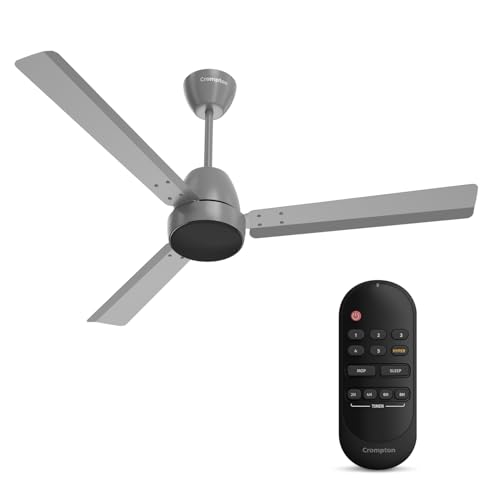
⚡ 24 W ActivBLDC efficiency; BEE 5-star rated; among the lowest wattage in this category; designed to cut electricity consumption sharply.
🌬️ 220 CMM air delivery; around 340–350 RPM depending on listing; 1200 mm sweep for steady room-wide cooling.
🎛️ Premium remote features; 1–5 speed settings, Hyper mode, 2H/4H/6H/8H timer; aluminium anti-rust blades and 4-year motor warranty.
Homes where at least one fan runs virtually around the clock — the bedroom of a light sleeper, a small home office, a child’s study room — will find the Crompton Energion Nucleoid to be among the best ceiling fans under 3000 in India. With ActivBLDC technology, it operates at just 24 W at Speed 5 (top speed), making it the lowest-wattage model in this shortlist, while still delivering 220 CMM at 340 RPM for genuine room-wide airflow.
The premium ergonomic remote sets it apart from the Caelum sibling. Speed settings 1–5 are complemented by a Hyper mode for burst-level maximum cooling when you first enter a hot room, plus timer functions at 2H, 4H, 6H, and 8H for automatic shutoff — all without requiring any wall-regulator setup. Powder-coated aluminum anti-rust blades ensure the kind of long-term stability that dusty Indian rooms demand, maintaining rotational balance even after months between cleaning sessions.
At just 24 W, the Nucleoid’s monthly consumption at 12 hours daily is approximately 8.6 units — the lowest in this roundup. Compare that to a 75 W induction fan at 27 units monthly, and you save roughly 18.4 units per month, or about ₹147 at ₹8 per unit. For a household running this fan in a bedroom 14–16 hours daily through summer, the annual saving can approach ₹2,000 from a single fan — a compelling case even against other BLDC peers in this list.
Pros
✅ Best-in-class 24 W power draw at top speed — lowest wattage in this roundup
✅ 220 CMM airflow and 340 RPM for comfortable, room-wide circulation
✅ Premium remote with Hyper mode and 2H–8H timer for precise overnight control
✅ Aluminium anti-rust blades with powder coat; 4-year motor + 2-year PCB warranty
Cons
❌ 340 RPM is slightly lower than some rivals, so max airspeed per square foot is marginally less punchy at peak
❌ Metallic Grey colorway, while sleek, may not suit warmer or wood-toned interior palettes
.
👉 Check Crompton Energion Nucleoid 1200 mm Latest Price on Amazon
5. Colorbot Stella 1200 mm BLDC — Spec-Heavy BLDC Beast for High-Usage Homes
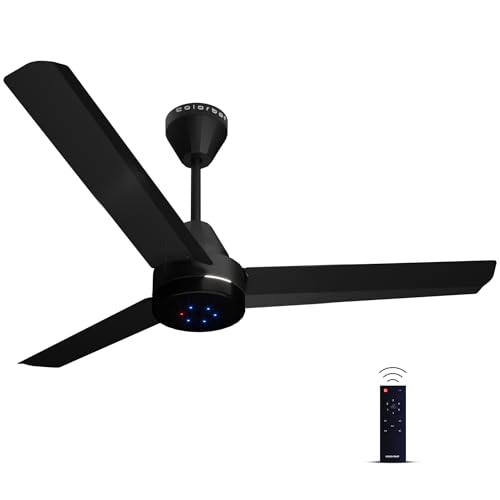
⚡ 26 W BLDC motor; energy-saving operation; strong efficiency-to-airflow ratio for high-usage homes.
🌬️ 220 CMM airflow at 370 RPM; 1200 mm sweep; aerodynamic blade profile for better throw and lower turbulence.
🎛️ Feature-heavy remote package; 6 speeds, reverse mode, timer, LED speed indication; 100% copper winding + sealed double ball bearings.
Top-floor hall spaces that stay warm well past midnight need a ceiling fan that can run hard and long without getting hot or noisy, and the Colorbot Stella BLDC is engineered for exactly that. This 1200 mm fan uses a BLDC motor rated at 26 W at top speed while spinning at 370 RPM and moving roughly 220 CMM — a rare combination of high airflow and ultra-low wattage even among BLDC ceiling fans in this price bracket.
Hardware depth is Colorbot’s signature here. A 100% copper winding motor, sealed double ball bearings, and aerodynamic blade shaping deliver the stability and noise profile typically found only in more expensive models. The sculpted blade design improves airflow throw and reduces aggressive blade-chop noise at higher speeds. Remote features include six speed settings, reverse mode for winter use, LED speed indication, and timer options — essentially packaging summer and heater-season comfort into a single, versatile fan.
Electricity math is where Stella makes its strongest case. At 26 W for 12 hours daily, monthly consumption sits at just 9.4 units versus 27 units for a 75 W induction fan — roughly 17.6 units saved per month, or about ₹140 at ₹8 per unit. Across three such fans in a heavy-use household, electricity savings over two summers can comfortably exceed ₹4,000, which explains why BLDC ceiling fan searches have spiked sharply in 2026.
Pros
✅ 370 RPM and 220 CMM airflow at just 26 W — among the best efficiency ratios in this segment
✅ 100% copper winding BLDC motor with sealed double ball bearings for low noise and long life
✅ 6-speed remote with reverse mode, boost, timer, and LED indicator for precise control
✅ 2+2 years warranty (4 years total) with pan-India service support
Cons
❌ Newer brand; long-term resale perception and national service depth are still growing.
❌ Bold charcoal and dual-tone colors may not blend seamlessly into ultra-minimal, all-white interiors.
👉 Check Colorbot Stella 1200 mm Latest Price on Amazon
6. V-Guard Windle Deco BLDC 1200 mm — Stylish RF-Remote Fan for Design-Conscious Buyers

⚡ 34 W BLDC motor; BEE 5-star rated; up to 53% claimed energy saving; made for lower bills with decorative styling.
🌬️ 222 m³/min airflow at 380 RPM; 1200 mm sweep; fast, punchy cooling for bedrooms and living rooms.
🎛️ RF remote with comfort modes; Sleep, Breeze, Boost, Reverse + 8-hour timer; powder-coated balanced blades for quieter operation.
Living rooms and master bedrooms where the fan needs to look as good as it performs have a strong contender in the V-Guard Windle Deco BLDC, one of the highly rated energy-saving ceiling fans in India. Available in Admiral Blue and other dual-tone finishes, it brings a decorative-contemporary design language to a segment usually dominated by plain whites, while delivering 222 CMM at 380 RPM on a 5-star-rated 34 W BLDC motor — one of the higher RPM figures in this roundup for noticeably snappier air movement.
Where the Windle Deco stands out is its RF remote, which allows point-anywhere control without requiring line-of-sight — a meaningful upgrade over IR remotes that need to be aimed at the receiver. The four dedicated wind modes are also thoughtfully differentiated: Sleep mode gradually reduces speed through the night, Breeze mode simulates natural airflow variation, Boost mode delivers instant maximum airflow, and Reverse mode makes it useful year-round in AC-supplemented rooms or during winter. An 8-hour timer rounds out the overnight comfort package.
Precision-balanced, powder-coated blades ensure wobble-free operation over extended periods, while the low-noise BLDC motor makes it genuinely suitable for bedrooms and WFH spaces where fan hum is a distraction. At 34 W for 12 hours daily, monthly consumption works out to roughly 12.2 units versus 27 units for a 75 W induction fan — saving approximately 14.8 units a month, or about ₹118 at ₹8 per unit. The decorative premium is real, but so is the engineering behind it.
Pros
✅ 222 CMM at 380 RPM for strong, fast airflow — among the highest RPM in this guide
✅ RF remote with four intelligent wind modes and an 8-hour timer for complete sleep comfort
✅ Decorative dual-tone design in Admiral Blue elevates room aesthetics beyond plain-fan options.
✅ Precision-balanced blades and a low-noise BLDC motor for quiet bedroom and WFH use
Cons
❌ 34 W draw is higher than the most efficient 24–28 W BLDC alternatives in this list
❌ A 2-year warranty is shorter than the 4-year motor coverage offered by Crompton’s rivals
👉 Check V-Guard Windle Deco BLDC 1200 mm Latest Price on Amazon
7. Polycab Wizzy Plus LED 1200 mm BLDC — Feature-Rich Smart Option for Multi-Use Rooms
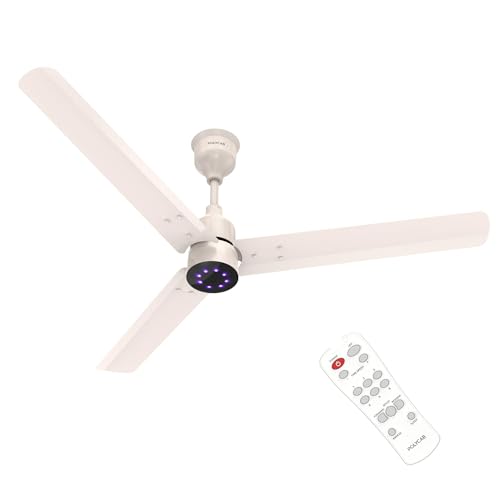
⚡ Approx. 35 W BLDC efficiency; BEE 5-star positioning; better running-cost control than old induction fans.
🌬️ Approx. 225 CMM airflow; 1200 mm sweep; tuned for flexible comfort in multi-use family rooms.
🎛️ Advanced remote logic; 7-speed control, Boost, Fine Speed micro-adjustment, reverse mode, breeze mode, and LED speed indicator.
Busy living-dining-kitchen combos where one fan has to satisfy the cook, the child doing homework, and the person on the sofa simultaneously need flexible, granular control — and that is precisely where the Polycab Wizzy Plus LED stands apart as the best ceiling fan under 3000 for performance grade requirements. Its BLDC motor draws around 35 W, moves approximately 225 CMM of air in a 1200 mm sweep, and delivers a control stack that no other model in this shortlist matches for sheer adjustment depth.
What makes Wizzy Plus genuinely different is how the remote logic is structured rather than just headline CMM. Seven standard speeds (1–6 plus Boost) are complemented by a 25-step Fine Speed mode that lets users micro-adjust airflow between two standard levels — valuable when you want something slower than Speed 3 but faster than Speed 2 on a humid evening. Reverse mode suits AC-assisted rooms in winter, while Breeze mode algorithmically varies fan speed to simulate natural wind patterns, reducing the fatigue that constant-speed airflow sometimes causes during long evenings. LED speed indicators confirm every command and can be switched off entirely for dark-room use.
At 35 W for 12 hours daily, monthly consumption is roughly 12.6 units versus 27 units for a legacy 75 W fan — a saving of about 14.4 units, or ~₹115 per month at ₹8 per unit. That efficiency is good, though not the best-in-class figure that the 24–28 W motors deliver. The tradeoff is a feature set that rewards buyers who genuinely use their fan as a comfort device rather than a set-and-forget appliance.
Pros
✅ ~225 CMM airflow with an efficient BLDC motor at approximately 35 W consumption
✅ 7-speed control plus Boost for instant maximum airflow when the room is oven-hot
✅ 25-step Fine Speed mode for ultra-precise comfort tuning between standard speed steps
✅ Reverse and Breeze modes make it genuinely useful year-round and in AC-assisted rooms
Cons
❌ Slightly higher wattage than 24–28 W champions; monthly savings are solid but not best-in-class
❌ A feature-loaded remote can initially overwhelm less tech-comfortable family members.
👉 Check Polycab Wizzy Plus LED 1200 mm Latest Price on Amazon
8. Polycab Aereo Purocoat 1200 mm — High-Speed Anti-Dust Tank for Harsh Environments

⚡ 75 W high-speed induction motor; 99.99% copper winding; built more for rugged airflow than ultra-low power draw.
🌬️ 230 CMM airflow at roughly 400–440 RPM; 1200 mm sweep; aggressive cooling for hot rooms and harsher environments.
🛡️ Nanova Purocoat protection; anti-dust, anti-rust, anti-fade, anti-bacterial finish; double ball bearing support for long-duty use.
Homes positioned near arterial roads, construction sites, or industrial belts — where fine dust settles on every surface within hours of cleaning — may still prefer a rugged induction fan like the Polycab Aereo Purocoat over more electronically sensitive BLDC alternatives. This 1200 mm ceiling fan spins at roughly 400–440 RPM and delivers about 230 CMM, powered by a 75 W induction motor with double ball bearings and 99.99% copper winding built for all-day, hard-environment running.
Its standout differentiator as the best ceiling fan under 3000 is the proprietary Nanova Purocoat surface treatment: blades and body are coated for anti-dust (approximately 50% reduced accumulation), anti-rust, anti-fade, and anti-bacterial properties. In heavily polluted Indian cities, coarse and oily dust can unbalance blades within weeks and make maintenance a tedious weekly chore. The Purocoat finish makes surface cleaning faster — one damp cloth pass instead of repeated scrubbing — while edge corrosion, which typically starts at blade tips in humid kitchens and semi-open rooms, is significantly slowed.
Power consumption is the unavoidable limitation in a segment now dominated by 24–35 W BLDC motors. At 75 W for 12 hours daily, monthly usage is about 27 units — nearly triple the load of a 24–28 W BLDC rival, translating to roughly ₹215–₹225 more on the electricity bill each month. If replacing an older 80–90 W non-rated fan, there is still a modest saving, but against the BLDC models in this guide, the trade-off is clear: physical toughness and raw airflow muscle in exchange for higher running costs.
Pros
✅ 230 CMM airflow and up to ~440 RPM for aggressive cooling in hot, large rooms
✅ Nanova Purocoat anti-dust, anti-rust, anti-fade, anti-bacterial finish suited to polluted environments
✅ Double ball bearing and 99.99% copper winding for heavy-duty, continuous running
✅ Strong Polycab brand presence with multi-color aesthetic options and wide service coverage
Cons
❌ 75 W power draw makes it significantly costlier to run than BLDC rivals at 24–35 W
❌ No remote control; purely regulator-driven and less convenient than smart BLDC peers
👉 Check Polycab Aereo Purocoat 1200 mm Latest Price on Amazon
How to Choose the Best Ceiling Fans Under ₹3,000 — The HVAC Buyer’s Compass
⚡ CMM vs RPM: Why Speed Alone Is a Trap
Manufacturers and offline shops still love shouting RPM because bigger numbers feel impressive, but for real-world comfort, CMM is the metric that matters. RPM measures how fast the blades rotate; CMM tells you how much air volume actually moves per minute. A 400 RPM fan with poor blade pitch and narrow sweep can move less air than a 350 RPM fan with well-designed aerodynamic blades and a full 1200 mm span.
Think of it simply:
➤ RPM = how fast the blades spin
➤ CMM = how much cool air actually reaches your skin
For typical Indian bedrooms and living rooms, target at least 210–230 CMM for genuine all-room comfort. That is why every top-ranked fan in this guide clusters around 220–230 CMM at 340–380 RPM rather than chasing 450+ RPM with noisier, less efficient motors.
⚡ Sweep Size, Room Size & Downrod — Getting the Geometry Right
Choosing the correct sweep and mounting height is as important as picking the right motor technology. Too small a fan leaves dead air in corners; too large a fan in a compact room creates turbulent, noisy airflow and wastes power. Use this as your planning reference:
| Room Size | Ideal Sweep | Typical Use Case | Blade-to-Floor Clearance | Approx. Downrod (8–10 ft ceilings) |
|---|---|---|---|---|
| Up to 75 sq. ft. | 900–1050 mm | Small bedroom, study, kitchen | ~8.5–9 ft | Short/standard rod |
| 76–140 sq. ft. | 1200 mm | Standard bedroom, dining, medium living room | ~8–9 ft | Standard 10-inch rod |
| 141–200 sq. ft. | 1400 mm or two × 1200 mm | Large bedroom, bigger hall | ~9–10 ft | 1–3 ft rod, depending on ceiling height |
| 200+ sq. ft. or open-plan | 1500 mm or multiple fans | Large living-dining combo | ~9–10 ft | 3–5 ft rods, or two 1200–1400 mm fans |
Always maintain at least 18 inches from the blade tip to the nearest wall for proper air circulation — otherwise, even the best ceiling fan under 3000 will underdeliver on comfort.
⚡ The 2026 BLDC Financial Calculus — How 24 W Beats 75 W in Under a Year
BLDC is not a marketing language — it describes a fundamentally different motor architecture that uses electronic commutation instead of fixed windings, cutting power draw by 50–68% compared to conventional AC induction motors. Use this formula to calculate monthly energy consumption at 12 hours of daily use:
➤ Monthly kWh = (Wattage × 12 Hours × 30 Days) ÷ 1,000
Comparing the Crompton Nucleoid at 24 W (most efficient in this guide) versus a 75 W induction fan:
➤ BLDC Fan (24W): 0.36 × 24 = 8.64 units/month
➤ Induction Fan (75W): 0.36 × 75 = 27.00 units/month
➤ Monthly Savings: 27.00 − 8.64 = 18.36 units
➤ Monthly Financial Savings: 18.36 units × ₹8 per unit = ₹146.88 (Approx. ₹147/month)
Over one year of heavy summer use, the single best fan with a BLDC motor saves approximately ₹1,760. If a BLDC model costs ₹1,200 more than a basic 75 W induction fan, the payback arrives in well under 9 months. After that, every month of running is pure savings on the electricity bill — and for households running three or four fans heavily from March to October, the cumulative annual savings can cross ₹5,000 without any lifestyle change.
⚡ Remote, Smart Modes & Voltage Stability — What Actually Matters in Indian Homes
Fans with basic remotes are now standard in the BLDC segment under ₹3000, but not all remote systems behave equally under Indian conditions.
➤ IR remotes (Atomberg Efficio Alpha, Crompton Caelum, Crompton Nucleoid) are line-of-sight dependent but simple, robust, and unaffected by voltage noise or wireless interference.
➤ RF remotes (V-Guard Windle Deco) allow “point anywhere” control, better suited when the fan is mounted high or off-center in large rooms.
When evaluating any ceiling fan in this budget, look for these four features:
➤ Timer and Sleep modes for gradual overnight speed reduction without manual intervention
➤ Boost or Hyper mode for instant full-speed cooling the moment you step into a hot room
➤ Reverse mode to gently push warm stratified air downward in winter, or smooth airflow in AC-supplemented rooms
➤ Voltage range of at least 120–285 V, so the BLDC motor maintains a stable speed through real Indian supply swings
⚡ Dust, Noise & Long-Term Durability — The Indian Nuance Most Buyers Overlook
Indian homes face a combination of roadside dust, construction debris, kitchen grease vapor, and seasonal pollen that generic fan reviews simply do not account for. Blade accumulation is not just an aesthetic issue — uneven dust loading shifts blade balance over weeks, gradually introducing wobble and vibration that worsens motor noise over time.
Fans with anti-dust coatings (Polycab Aereo Purocoat), powder-coated aluminum blades (Crompton Caelum, Crompton Nucleoid), and aerodynamic low-drag profiles are meaningfully easier to clean and stay balanced longer between wipe-downs. For motor noise, sealed double ball bearings (Colorbot Stella, Crompton models) are superior to sleeve bearings in long-haul, continuous-use scenarios. And for study rooms or light-sleeper bedrooms specifically, mid-speed acoustic behavior— not just maximum-speed numbers — is what separates genuinely quiet best fans under 3000 from those that are only quiet in listing descriptions.
Final Verdict
Among the ceiling fans under 3000 featured above, one pattern is unmistakable: BLDC motors delivering 220–230 CMM at 24–35 W have become the new standard, while 75 W high-speed induction fans now occupy a narrow specialty niche for harsh, dusty, or rugged environments. The sharpest 2026 buyer treats a ceiling fan as a hybrid appliance and mini-HVAC device — judged on its ability to deliver consistent, room-filling comfort at the lowest possible monthly kWh cost, not just on its sticker price.
💰 Budget Value King: Crompton Energion Nucleoid 1200 mm BLDC
For pure “maximum airflow per watt” value, the Crompton Energion Nucleoid earns the Budget Value King title this year. Drawing just 24 W at top speed while delivering 220 CMM — the lowest wattage in this entire guide — it combines Crompton’s proven ActivBLDC reliability, a premium remote with Hyper mode and full timer functions, aluminum anti-rust blades, and a class-leading 4-year motor warranty. For families running fans 12–16 hours daily through summer in bedrooms and study rooms, the Nucleoid’s wattage discipline translates into the fastest real-world payback of any model reviewed here.
🤫 Premium Silent Performer: Atomberg Efficio Alpha 1200 mm BLDC
For buyers who place brand maturity, ultra-stable low-voltage performance, and refined acoustics above sheer feature density, the Atomberg Efficio Alpha 1200 mm BLDC remains the Premium Silent Performer of this guide. Its combination of 230 CMM airflow, 365 RPM, 28 W draw, smart IR remote with LED speed indicator, and proven quiet behavior across bedrooms and home offices — backed by Atomberg’s pan-India service network and inverter-optimized electronics — makes it one of the most trusted ceiling fans under ₹3000 in India right now. This is the fan for master bedrooms and home offices, where even minor bearing sounds or subtle speed fluctuations can interrupt sleep or concentration.
Even the best BLDC ceiling fans under 3000 will underperform if installed incorrectly. Keep blade tips at least 18 inches from walls or tall furniture, maintain 8–9 feet of blade-to-floor clearance for optimal airflow distribution, and use an appropriately sized downrod for your ceiling height. Match the 1200 mm sweep models in this guide to rooms between 75 and 140 sq. ft.; for larger spaces, consider stepping up to a 1400 mm fan or adding a second unit rather than expecting one ceiling fan under ₹3000 to cool an oversized room. Every rupee spent choosing the right motor and the right sweep is a rupee saved every month on your electricity bill for years to come.



![OnePlus Nord Buds 4 Review [Price, ANC & Battery Verdict]](https://gadgetveda.com/wp-content/uploads/2026/10/OnePlus-Nord-Buds-4-Review-GadgetVeda-150x150.webp)

![5 Best Smart TVs Under ₹15,000 in India [2026]](https://gadgetveda.com/wp-content/uploads/2026/10/Best-Smart-TVs-Under-₹15000-in-India-150x150.webp)


![OnePlus Nord Buds 4 Review [Price, ANC & Battery Verdict]](https://gadgetveda.com/wp-content/uploads/2026/10/OnePlus-Nord-Buds-4-Review-GadgetVeda-300x167.webp)

![5 Best Smart TVs Under ₹15,000 in India [2026]](https://gadgetveda.com/wp-content/uploads/2026/10/Best-Smart-TVs-Under-₹15000-in-India-300x167.webp)