


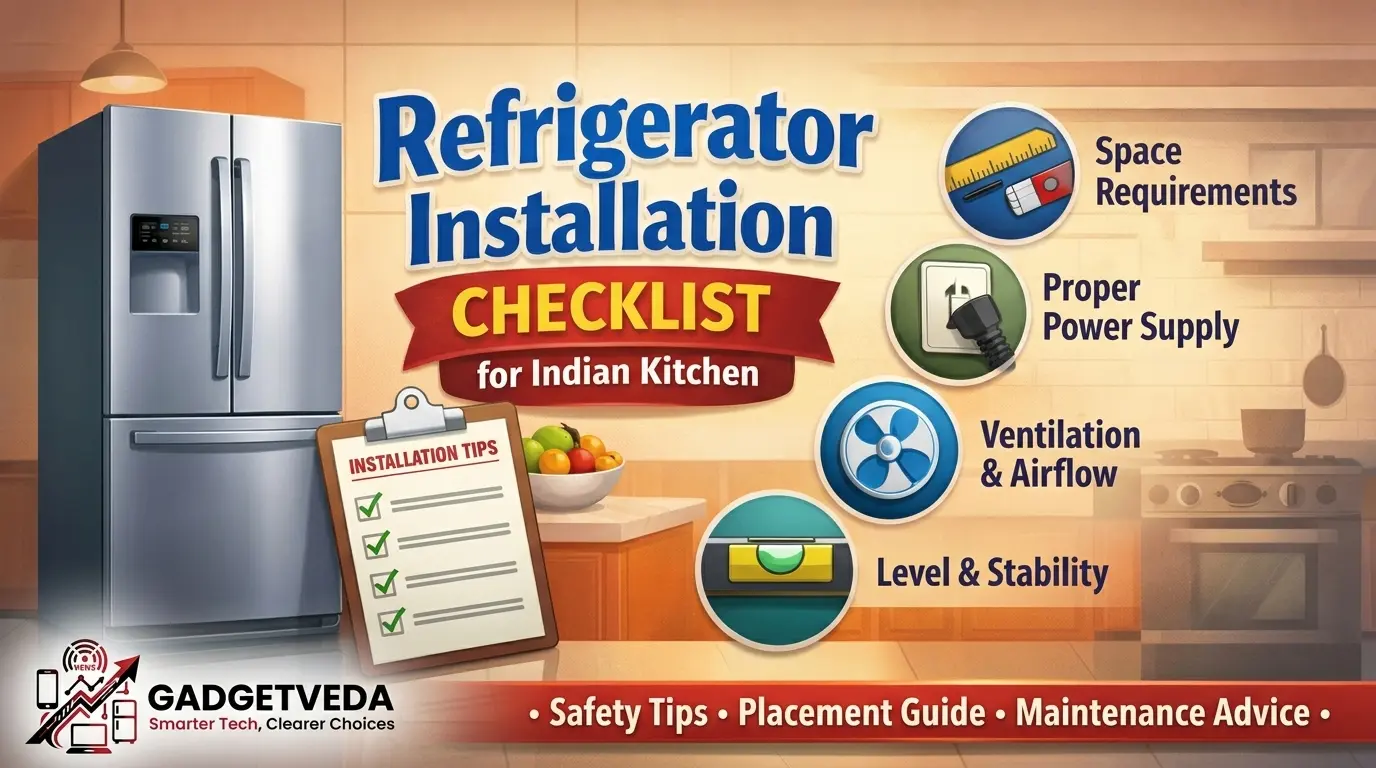
You’ve done the research, compared the models, checked the BEE star rating, and finally brought home the refrigerator you wanted. The hard part is over — or so it feels. What most buyers don’t realize is that the first 24 hours after delivery are just as important as the purchase decision itself. Poor placement, wrong ventilation gaps, skipping the stabilizer, or loading food too soon can undo all the careful thought you put into buying the right fridge.
At GadgetVeda, we’ve put together this practical refrigerator installation checklist specifically for Indian kitchens — because our homes, our kitchen layouts, our voltage conditions, and our summer temperatures all come with unique challenges that generic installation guides simply don’t address. Whether this is your first fridge or an upgrade, run through these 10 checkpoints before and after your fridge is plugged in.
📦 GadgetVeda Picks: Best Refrigerators in India by Budget
Found this guide helpful? Share it — or explore our top-rated refrigerator picks across every budget:
❄️ Best Refrigerators Under ₹10,000 in India— Compact direct-cool picks for small kitchens and individuals
🧊 Best Refrigerators Under ₹12,000 in India— Reliable entry-level single-door options from trusted brands
🌟 Best Refrigerators Under ₹15,000 in India— The sweet spot for couples and small families
⚡ Best Refrigerators Under ₹18,000 in India— Mid-range frost-free models with stronger star ratings
🏆 Best Refrigerators Under ₹20,000 in India— Most popular tier; double-door inverter fridges for everyday families
🚀 Best Refrigerators Under ₹25,000 in India— Premium picks with high BEE ratings and spacious builds
Why Getting Installation Right Matters More Than You Think
A refrigerator that is incorrectly placed, poorly ventilated, or plugged into an unstable power supply doesn’t just underperform — it wears out faster. Compressor stress from heat buildup, voltage fluctuations causing motor damage, and door seal issues from an unlevelled unit all compound quietly over the years, shaving years off an appliance that should comfortably last 12–15 years with proper care.
India’s ambient kitchen temperatures in summer can easily hit 38–42°C in many cities — significantly higher than the 25°C reference temperature used in standard BEE lab tests. This means every installation variable — ventilation gap, heat source proximity, power stability — has a measurably larger impact on your fridge’s performance and longevity here than it would in a temperate climate. Getting these right from day one is the best thing you can do for your new purchase.
10-Point Refrigerator Installation Checklist for Indian Kitchens
Checkpoint 1: Let the Fridge Stand Upright Before Switching On
This is the single most important — and most commonly skipped — step in any refrigerator installation checklist. During delivery and transport, fridges are often tilted or laid horizontally to navigate stairways and narrow corridors. When this happens, the compressor oil can flow out of the compressor housing and into the refrigerant lines.
If you switch the fridge on immediately after delivery in this condition, the compressor runs dry, generating excessive heat and mechanical stress that can cause permanent damage within minutes.
What to do:
➤ If the fridge was transported fully upright, wait at least 1 hour before switching on
➤ If it was tilted or laid on its side at any point, wait a minimum of 2–4 hours upright before powering on
➤ When in doubt, wait 4 hours — it costs you nothing and protects a significant investment
Checkpoint 2: Choose the Right Location in Your Kitchen
Location is one of the most consequential fridge placement tips and directly affects both daily convenience and long-term efficiency. In Indian kitchens, where multiple heat sources are often packed into a small space, this decision deserves more thought than most buyers give it.
Avoid placing the fridge:
➤ Directly next to or opposite the gas stove or hob — radiant and convective heat from cooking directly raises the fridge’s ambient temperature and increases compressor run time
➤ Under a window where afternoon sun can fall on it for several hours, particularly in west-facing kitchens
➤ In enclosed alcoves or cabinets without adequate air circulation on all sides
Ideal placement:
➤ In the coolest corner of the kitchen, away from direct sunlight and the cooking zone
➤ With clear access from at least two sides for ventilation and maintenance
➤ Close enough to a dedicated power socket that you don’t need an extension cord
Checkpoint 3: Maintain the Correct Fridge Ventilation Gap
The fridge ventilation gap is one of the most technically specific items on this checklist — and one of the most ignored. The condenser coils at the back (or underside, on some newer models) need to continuously release heat into the surrounding air. If the fridge is pressed against a wall or cabinet, that heat accumulates, the compressor has to work harder to compensate, and both efficiency and lifespan suffer.
Minimum recommended clearances for Indian conditions:
| Position | Minimum Clearance |
| Back of the fridge | 5–6 cm from the wall |
| Both sides | 3–5 cm each |
| Top | 15–20 cm (for overhead heat release and access) |
In Indian summers, where ambient kitchen temperatures are significantly higher than lab test conditions, it is advisable to maintain clearances at the upper end of these ranges — or exceed them if space allows. Even a few extra centimeters of rear clearance can meaningfully reduce compressor run time and monthly electricity consumption. This is one refrigerator installation tips in India that directly shows up on your electricity bill.
Related: Refrigerator Buying Mistakes in India
Checkpoint 4: Level the Fridge Properly
A fridge that isn’t level causes more problems than most buyers expect. An unlevel unit means the door doesn’t hang correctly under its own weight, which leads to an incomplete seal, continuous cold air leakage, and the compressor cycling more often to compensate.
Most refrigerators come with adjustable front leveling feet — typically two front feet that can be turned clockwise or counterclockwise to raise or lower each corner independently.
How to level correctly:
➤ Place a spirit level (or use a free smartphone level app) on the top surface of the fridge
➤ Adjust front feet until the bubble sits centered both side-to-side and front-to-back
➤ For double-door and multi-door models, a very slight forward tilt (1–2°) is sometimes recommended to help doors swing shut on their own — check your model’s manual.
Do not skip this step. An unlevel fridge is one of the most common causes of premature door gasket wear and ongoing energy waste.
Checkpoint 5: Use a Stabilizer — Especially in India
This is perhaps the most critical India-specific item on the refrigerator installation checklist. Voltage fluctuations are a persistent reality across large parts of India — in tier-2 and tier-3 cities, semi-urban areas, and even in many urban localities during peak summer when grid loads are highest.
A stabilizer for refrigerator use protects against:
➤ Under-voltage (low voltage during peak load hours) — causes the compressor motor to draw higher current and overheat
➤ Over-voltage (voltage spikes from sudden load shedding and restoration) — can damage the compressor, PCB, and motor windings in a single event
➤ Frequent switching — repeated on-off cycles during voltage instability, cause compressor wear
What type of stabilizer to use:
➤ For refrigerators up to 300L: a 500 VA to 1 KVA stabilizer is typically sufficient
➤ For larger double-door models (300–500L): opt for a 1 KVA stabilizer with a wide input voltage range (typically 130V–280V)
➤ Look for models with a time delay feature — this prevents the compressor from restarting immediately after a voltage restoration, protecting it from back-to-back start-up stress.
Many modern premium inverter refrigerators come with built-in voltage protection and may specify “stabilizer-free operation” up to a certain voltage range. Check your model’s specifications before purchasing — but if in doubt, a good stabilizer is inexpensive insurance for a significant appliance.
Checkpoint 6: Check the Door Hinge Direction and Swing Clearance
Before the fridge is placed in its final position, verify that the door opens in the direction that works for your kitchen layout. Most single-door fridges in India open right-to-left by default. If your kitchen layout requires a left-hinged opening, this needs to be confirmed before installation — and ideally before purchase, since not all models support hinge reversal.
For double-door and French door models, ensure there is adequate clearance in front of the fridge for both doors to open fully simultaneously — typically at least 90–100 cm of clearance in front of a standard double-door fridge. Measure this against your kitchen’s actual aisle width or walkway space before positioning.
Related: Refrigerator Electricity Consumption Per Month Guide
Checkpoint 7: Inspect and Test the Door Gasket on Day One
The door gasket — the rubber seal that runs around the entire perimeter of the fridge door — is your fridge’s first line of defense against cold air loss. A gasket that is creased, kinked, or not seated properly from day one will quietly waste electricity every hour the fridge is running.
Day-one gasket check:
➤ Run your hand slowly along the full perimeter of the closed door. You should feel no cold air escaping at any point.
➤ Perform the paper test: close the door on a sheet of A4 paper. Pull the paper out slowly — you should feel meaningful resistance. If it slides out easily, the gasket is not sealing properly.
➤ Check for any visible creases or folds caused during transport — these can sometimes be gently smoothed out by warming the area with a hairdryer on low heat and pressing the gasket back into shape.
If the gasket fails the paper test even after adjustment, report it to the dealer or brand service center immediately — this is covered under the product warranty.
Checkpoint 8: Set the Temperature Correctly from the Start
Many first-time buyers leave the fridge on the factory default temperature setting and never revisit it. In Indian conditions, getting the temperature right from day one matters for both food safety and energy efficiency.
Recommended temperature settings for Indian homes:
➤ Fresh food compartment: 3–5°C — cold enough for safe food storage without overcooling
➤ Freezer compartment: -15°C to -18°C — sufficient for ice and frozen food storage without running the compressor harder than needed
Avoid setting the refrigerator to maximum cooling out of habit. In Indian summers, even a setting of “3” or “medium” on a dial thermostat is typically sufficient for most households. Overcooling is one of the quietly persistent energy-wasting habits that inflates monthly electricity bills without adding meaningful benefit.
Checkpoint 9: Wait Before Loading Food
This one of the crucial refrigerator installation tips in India is simple but important. After switching on for the first time, the fridge needs time to reach and stabilize at its target internal temperature before you load it with food.
Recommended waiting times:
➤ Switch on and let the fridge run empty for at least 1–2 hours before any loading
➤ For larger double-door and side-by-side models, wait 2–3 hours
➤ Load food in stages rather than all at once — a sudden large load of ambient-temperature food forces the compressor to work significantly harder to pull the internal temperature back down.
Never load warm or hot food directly into a freshly installed fridge. This is doubly true in Indian kitchens, where food is often packed and stored while still warm.
Checkpoint 10: Run a 24-Hour Performance Check
Once your fridge is installed, leveled, stabilized, and loaded, give it a full 24-hour observation period before declaring the installation complete. During this time, check:
✅ Cooling consistency: Open the fridge after 3–4 hours — the fresh food section should feel noticeably cold, and the freezer should have begun producing ice
✅ Unusual noises: Some minor sounds (gurgling, soft hissing of refrigerant, gentle fan hum) are completely normal. Loud rattling, persistent clicking, or a vibrating body usually indicates a leveling issue or loose internal component — resolve these within the warranty window
✅ Door seal integrity: After the first few hours of operation, run the paper test again on all doors
✅ Compressor run pattern: In normal operation, the compressor should cycle on and off periodically. If it runs non-stop for several hours without the fridge reaching temperature, contact the brand service center — this may indicate a refrigerant or seal issue that needs to be addressed under warranty
✅ External heat: Gently feel the sides and back of the fridge. Some warmth is normal as the condenser releases heat. Excessive heat, especially on the sides, suggests the ventilation gap may be insufficient
Conclusion
A refrigerator installation checklist takes less than 30 minutes to run through — but the benefits last the entire life of the appliance. Getting the fridge ventilation gap right, using a proper stabilizer for refrigerator protection, choosing the correct placement, leveling accurately, and waiting before loading food are all small investments of time that directly protect a purchase you’ll depend on every single day.
Follow these refrigerator installation tips for India, and you’re not just setting up an appliance — you’re giving it the best possible start for the next 12–15 years.
At GadgetVeda, we want your refrigerator purchase to deliver full value from day one. Once your installation is sorted, explore our best refrigerators in India by budget guides to help friends and family make equally well-informed choices.



![12 Best Earbuds Under ₹3,000 in India [2026] | GadgetVeda](https://gadgetveda.com/wp-content/uploads/2026/09/Best-Earbuds-Under-₹3000-in-India-150x150.webp)
![11 Best Washing Machines Under ₹50,000 in India [2026]](https://gadgetveda.com/wp-content/uploads/2026/09/Best-Washing-Machines-Under-₹50000-in-India-150x150.webp)
![14 Best Wireless Earbuds Under ₹2,000 in India [2026]](https://gadgetveda.com/wp-content/uploads/2026/09/Best-Wireless-Earbuds-Under-₹2000-in-India-150x150.webp)
![10 Best Wireless Earbuds Under ₹1,000 in India [2026]](https://gadgetveda.com/wp-content/uploads/2026/09/Best-Wireless-Earbuds-Under-₹1000-in-India-150x150.webp)


![12 Best Earbuds Under ₹3,000 in India [2026] | GadgetVeda](https://gadgetveda.com/wp-content/uploads/2026/09/Best-Earbuds-Under-₹3000-in-India-300x167.webp)
![11 Best Washing Machines Under ₹50,000 in India [2026]](https://gadgetveda.com/wp-content/uploads/2026/09/Best-Washing-Machines-Under-₹50000-in-India-300x167.webp)
![14 Best Wireless Earbuds Under ₹2,000 in India [2026]](https://gadgetveda.com/wp-content/uploads/2026/09/Best-Wireless-Earbuds-Under-₹2000-in-India-300x167.webp)
![10 Best Wireless Earbuds Under ₹1,000 in India [2026]](https://gadgetveda.com/wp-content/uploads/2026/09/Best-Wireless-Earbuds-Under-₹1000-in-India-300x167.webp)