A direct drive washing machine has no belt to slip, snap or squeal. That pitch is partly true. The catch is that in most Indian homes, hard water damages parts a direct-drive system never touches: heating elements, rubber seals, inlet valves and drain pumps.
So which one lasts longer? Direct drive usually wins on drive-train wear and noise. A belt-drive washing machine can still be the smarter buy when the price gap is large, and you can get quick local servicing. This guide explains how each system works, what hard water does inside the machine, and which option fits each budget.
Direct Drive vs. Belt Drive Washing Machine: Which Lasts Longer?
👉 Direct drive removes the belt and pulley, so the most obvious drive-train wear item is gone.
👉 Belt drive adds a belt that can wear or slip, but it is a simple part that is often easier to replace.
👉 Hard water is a separate threat. Scale builds up mainly on heaters, seals, valves, and the drum, whichever drive you choose.
👉 Warranty terms matter more than the label. Check what the motor warranty covers and what it excludes.
How Each Drive System Works
Belt drive: motor, belt, and pulley
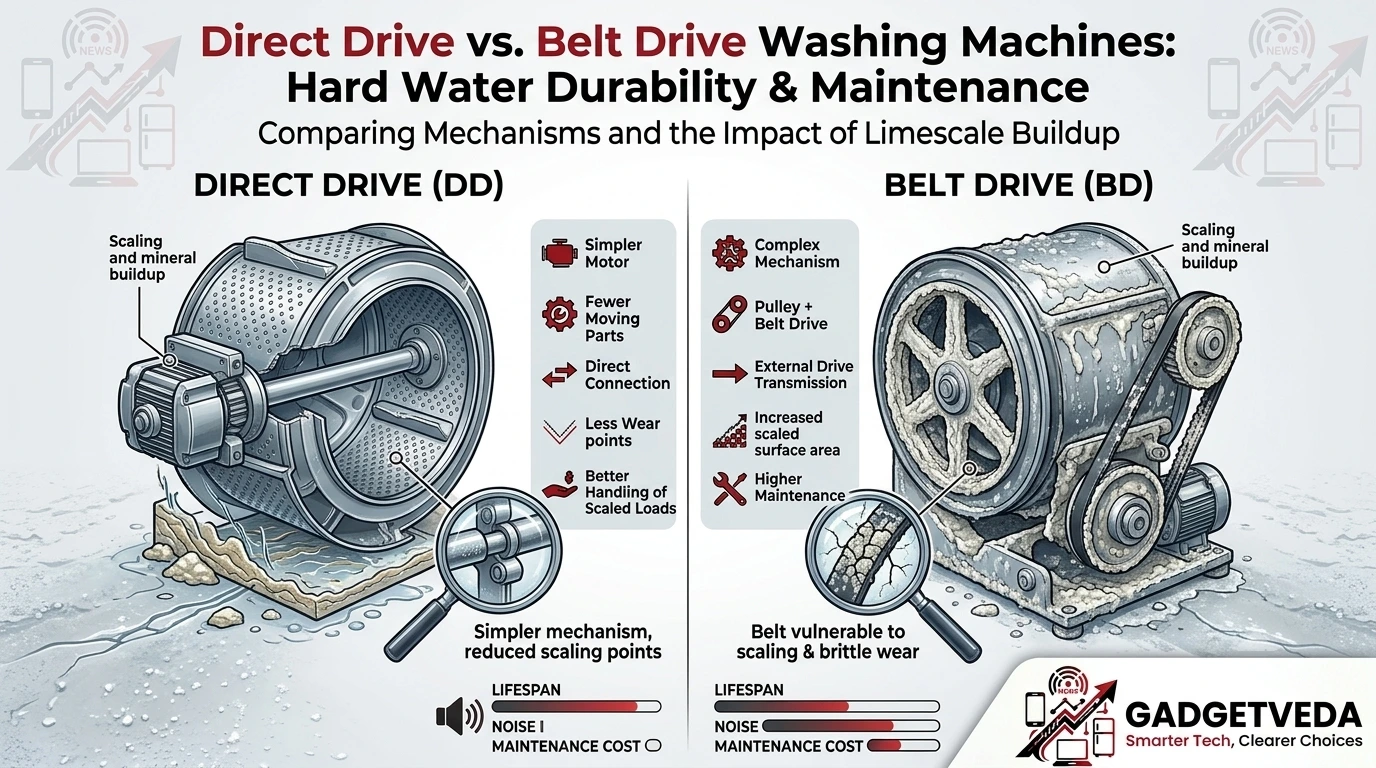
In a belt drive washing machine, the motor sits beside or below the tub. A rubber belt carries its rotation to a pulley, which turns the drum or the wash mechanism.
Every spin therefore passes through extra moving parts. They create friction and some noise, and the belt is a wear item that eventually needs inspection or replacement.
Direct drive: motor connected to the drum
In a direct drive washing machine, the motor connects directly to the drum shaft instead of using a belt and pulley. Fewer parts sit between the motor and the drum, so there are fewer places for slippage, rubbing, and belt-related noise.
The exact layout depends on the model and on whether it is a front-load or top-load machine. What stays the same is the missing belt.
Direct drive and inverter are not the same thing
These terms describe different parts of the machine. Direct drive describes the mechanical link between the motor and drum. Inverter describes the electronics that control motor speed and torque.
Many direct drive machines also use inverter control, but a belt can coexist with an inverter motor. Read the specification sheet for both terms instead of assuming one implies the other.
What Hard Water Does Inside a Washing Machine
Hardness comes mainly from dissolved calcium and magnesium. India’s drinking water standard, IS 10500, sets an acceptable limit of 200 mg/L total hardness and a permissible limit of 600 mg/L when no better source exists. USGS classifies water above 180 mg/L as very hard.
A TDS meter does not measure hardness. TDS counts all dissolved solids, so a hardness test strip or a lab test is a better guide for borewell or tanker water.
When hard water is heated, minerals crystallize and deposit on the drum, the heating element, and the seals. Thick scale on a heater makes it overheat and can lead to burnout.
| Part | Hard-water risk | Does drive type change it? |
| Heating element | Scale insulates it, causing overheating and failure | No |
| Door gasket (front-load) | Residue and minerals promote hardening and mildew | No |
| Inlet valve and filter | Grit and scale restrict water flow | No |
| Drain pump | Mineral particles can accelerate wear | No |
| Drive belt | Not damaged by scale itself | Belt drive only |
| Tub bearings and seal | Leaks and corrosion can follow seal failure | Indirectly |
The table explains why “direct drive lasts longer in hard water” is only half an answer. Direct drive removes one wear item. It does not protect the machine from scale.
Direct Drive vs Belt Drive: Key Differences
| Metric | Direct Drive | Belt Drive |
| Drive path | Motor connects directly to the drum shaft | Motor drives the drum through a belt and pulley |
| Noise and vibration | Usually lower because belt-related movement is removed | Can be higher, depending on belt condition and load |
| Wear items | No drive belt to replace | Belt and pulley need periodic checks |
| Repair approach | Motor or control faults may need brand-specific service | Belt replacement is often a simple job |
| Typical price position | Often found in higher-priced models | More common in budget and mid-range models |
Noise ultimately depends on the whole machine. Installation, load balance, floor stability, and spin speed all play a role. Compare published noise ratings where a brand provides them, not just the drive label.
Noise and Vibration in Indian Homes
Noise matters more in a typical Indian flat than the spec sheet suggests. Washers often sit in small utility balconies, kitchens or passages beside bedrooms, and tiled floors and thin walls carry vibration.
A few factors can matter more than the drive type:
➡️ Level the machine. An unlevel base amplifies vibration at high spin speeds.
➡️ Balance the load. One heavy wet blanket can throw a drum off balance.
➡️ Check the floor. Tiled balconies and loose platforms transmit more vibration.
➡️ Allow for monsoon loads. Damp, heavy clothes and frequent washes make load balance more important.
If your washer sits near a bedroom, a direct drive washing machine is the safer bet. If it sits in a ground-floor utility area, belt noise is less likely to bother you.
Repairs, Warranty and Ownership Cost
Motor warranty is not a full warranty.
Many brands advertise long motor warranties on direct drive or inverter motors. One Indian manufacturer’s published terms describe its extended motor cover as a parts warranty only, while the standard product warranty is shorter. Another advertises a 10-year warranty on its direct drive motors, with advice to verify model-specific terms before buying.
Ask before you buy:
❓ Does the warranty cover labor and visiting charges?
❓ Is the control board covered separately?
❓ Does it exclude damage from water quality, scale, or poor drainage?
❓ What happens if you move the product to a new address?
Where belt drive can be cheaper
A snapped or loose belt is a simple fix, and local technicians generally know the job. Direct drive faults often involve the motor, its control board, or the shaft assembly, so authorized service is more likely.
That does not make direct drive more expensive to own. It means you should confirm service availability in your city.
Pros & Cons of Direct Drive Washing Machines
Pros
✅ Quieter operation from fewer moving parts.
✅ No belt to slip or replace.
✅ Smoother spin with less drive vibration.
✅ Longer motor warranty is common.
Cons
❌ Higher price than similar-capacity belt models.
❌ Specialist repair often needed for motor faults.
❌ Hard water still damages heaters and seals.
Pros & Cons of Belt Drive Washing Machines
Pros
✅ Lower price at most capacities.
✅ Simple repair for belt and pulley issues.
✅ Proven design with wide service familiarity.
✅ Wider choice in semi-automatic ranges.
Cons
❌ Belt wear needs periodic inspection.
❌ More noise possible as parts age.
❌ Vibration risk rises with unbalanced loads.
How to Protect Either Machine From Hard Water
The most important durability decision is water care. A well-maintained belt drive machine can outlast a neglected direct drive one.
➡️ Test your hardness. Use a hardness strip or lab test instead of relying on TDS.
➡️ Use a prefilter. An inlet filter catches grit before it reaches the valve.
➡️ Consider a softener or conditioner. Whole-home treatment protects heaters, taps, and pipes as well.
➡️ Descale on schedule. Follow the manual for descaling frequency and use compatible products.
➡️ Dry the gasket. In humid monsoon months, wipe the door seal and leave the door ajar.
➡️ Clean filters. Check drain and inlet filters regularly.
Our hard water washing machine care guide for Indian homes covers these steps in detail.
Which Should You Buy?
Choose direct drive if:
✅ Your washer is close to bedrooms or living areas.
✅ You run daily loads and want fewer wear parts.
✅ An authorized service center operates in your city.
✅ Your hard water is managed with a filter or softener.
Choose belt drive if:
✅ Your budget is tight, and the premium is large.
✅ You value easy local repair.
✅ You wash occasionally, or your machine is in a utility space.
✅ You prefer a simpler mechanical design.
The rule we recommend: Pay extra for direct drive only when noise, daily use, and warranty terms justify the premium. If the price gap forces a trade-off between direct drive and a larger drum or better service access, choose the option that fits your household.
Budget Guide: Which Washing Machine Range Fits You?
Use this table to jump to the right price band. Verify current prices and specifications on each guide.
| Budget range | Who should consider it | Guide |
| Under ₹10,000 | First-time buyers and small households needing a basic, low-cost washer | Best Washing Machines Under 10000 |
| Under ₹15,000 | Families seeking more capacity or convenience without a big spend | Best Washing Machines Under 15000 |
| Under ₹20,000 | Buyers comparing fully automatic features and trusted brands | Best Washing Machines Under 20000 |
| Under ₹25,000 | Households wanting a step up in features, drum size and build | Best Washing Machines Under 25000 |
| Under ₹30,000 | Buyers prioritizing quieter operation and richer wash programs | Best Washing Machines Under 30000 |
| Under ₹35,000 | Larger families and frequent washers who want better motor coverage | Best Washing Machines Under 35000 |
| Under ₹40,000 | Buyers who want premium features, larger capacity, and strong support | Best Washing Machines Under 40000 |
FAQs
1. Is direct drive better than belt drive?
Direct drive usually runs quieter and removes the belt as a wear part. Belt drive is cheaper and often easier to repair. Neither protects the machine from scale.
2. Which washing machine lasts longer in hard water?
Water care often matters more than drive type. Descaling, filters, and gasket care protect heaters, seals, and valves. Direct drive only removes belt wear.
3. Does a direct drive washing machine use less electricity?
It can lose less energy through friction, but heating water usually has a bigger effect on electricity use. Compare the BEE label for the exact model.
4. Is a belt drive washing machine noisier?
Often, but not always. Noise also depends on installation, load balance, floor stability, and spin speed.
5. Does a longer motor warranty mean the machine will last longer?
No. It covers the motor under the stated conditions. Read the exclusions and check the standard product warranty.
6. Can hard water damage a direct drive washing machine?
Yes. Scale can still affect the heater, seals, valves, and pump regardless of the drive type.
7. How do I know if my water is hard?
Use a hardness test strip or lab test. A TDS meter measures dissolved solids, not hardness.
8. Should I buy direct drive on a tight budget?
Only if the model also meets your capacity and service needs. Do not stretch your budget solely for the label.