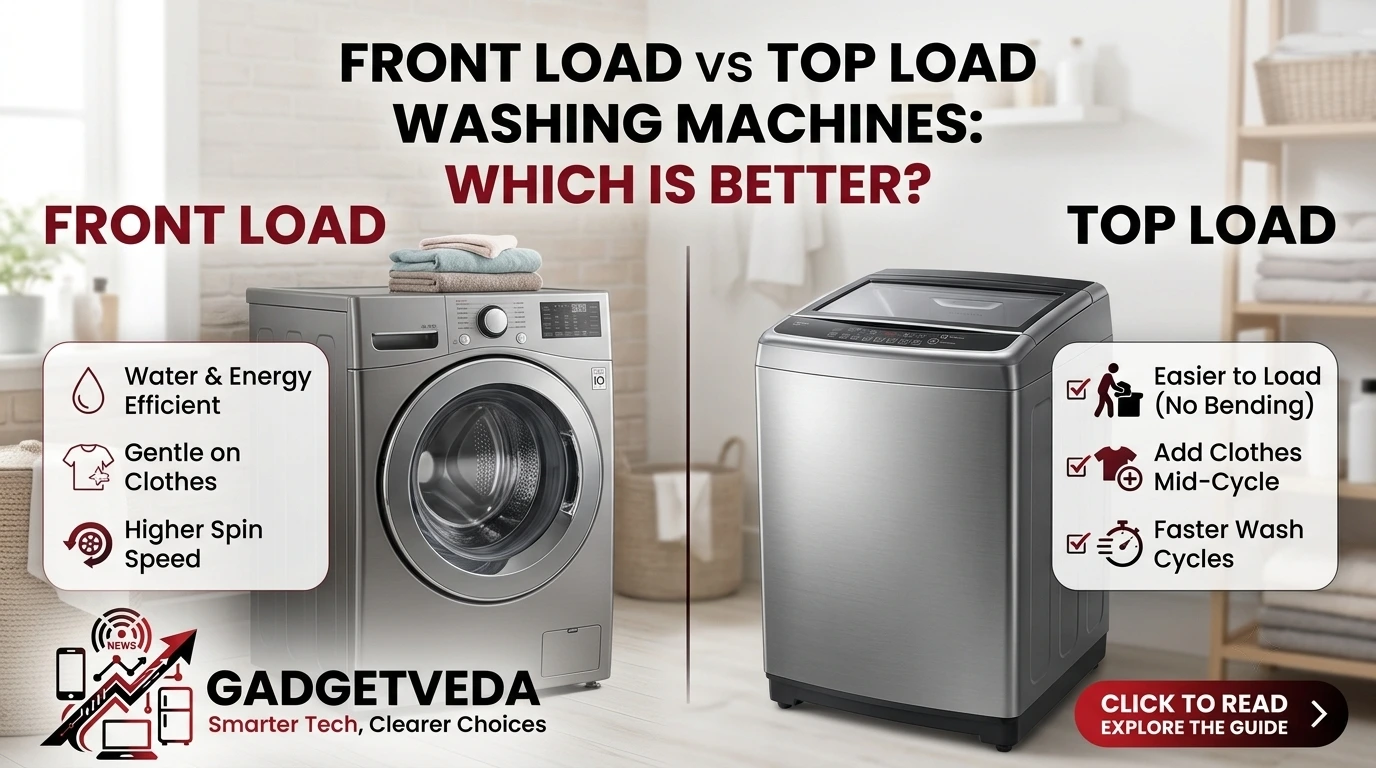
Most guides on front-load vs. top-load washing machine choices stop at “front loaders clean better, top loaders are convenient.” That does not help much when your borewell water leaves white crust on the tap, your society cuts supply at 9 AM, or the service call costs more than you planned.
This guide compares both types on what Indian households actually pay for: water, detergent, descaling, repairs, and routine cleaning. You will find a running cost matrix, a hard-water verdict, and a drum cleaning schedule you can follow.
Quick Verdict: Which One Should You Buy, Front Load or Top Load Washing Machine?
| Your situation | Better pick |
| Water is scarce or tanker-supplied | Front load |
| Hard borewell water, and you want low upkeep | Top load with a hard-water mode |
| Delicates, woolens, sarees | Front load |
| Budget under ₹20,000 | Top load |
| Compact space, back trouble, or you like to add forgotten clothes mid-wash | Top load |
| Heavy stains, and you want a heater and steam | Front load |
| Unreliable water pressure | Check the model’s minimum pressure rating first |
Front Load vs Top Load Washing Machine: How the Two Work
In a front loader, the drum turns on a horizontal axis. Clothes are lifted and dropped through a shallow pool, so the machine needs less water to wash them. In a top loader, the drum or pulsator turns on a vertical axis and the clothes sit in deeper water.
That single design difference explains most of what follows. Front loaders save water, but their sealed door needs a rubber gasket that traps damp. Top loaders use more water, but they have no gasket to grow mould.
Water Use: The Biggest Difference
As a rule of thumb, a front loader uses about 40–70 liters per load. A fully automatic top loader uses about 80–120 liters. Your actual figure depends on the program, load size, and water-level setting.
Worked example: a family running 5 loads a week.
➡️ Front-load at about 60 L per load uses roughly 15,600 L a year.
➡️ Top load at about 100 L per load uses roughly 26,000 L a year.
➡️ The gap is about 10,400 liters a year.
On a municipal connection, that saving is small in rupees. It matters in three cases: tanker-dependent homes, borewell setups where you pay for pumping electricity, and cities with rationed supply.
Which Washing Machine Is Better for Hard Water?
Neither type wins automatically. Hard water carries dissolved calcium and magnesium. When heated, these form limescale on heating elements, drums, seals, and hoses. Each design suffers differently:
➡️ Front loaders heat water for warm and hot cycles, so the element collects scale. Left alone, it can fail early.
➡️ Top loaders mostly wash with unheated water. Scale shows up as white crust on the tub, pulsator and drain hose, which is easier to spot and wipe away.
➡️ Detergent effect: hard water weakens detergent. Whites turn grey and clothes feel stiff in both types.
Many brands now sell models with a hard-water wash mode or anti-scale feature in both formats. Treat percentage claims on the box as brand claims and check the feature on the actual model page.
GadgetVeda’s take: for the least upkeep in hard water, choose a top loader with a hard-water mode. If you prefer a front loader for cleaning quality, descale it monthly, and consider an inlet filter or softener if your water is very hard. Test your water’s TDS before you buy.
Front Load Detergent Cost vs Top Load
Front loaders need less detergent because the water volume is smaller. A common dose is about 30–40 g for a 6–7 kg load. Use low-foam detergent made for front loaders. Too much foam leaves residue and slows the rinse.
Top loaders have more water to treat, so a larger dose is typical. Here is the modeled annual cost at 5 loads a week:
| Item | Front load | Top load |
| Detergent per load (assumption) | 35 g | 55 g |
| Annual detergent used | about 9.1 kg | about 14.3 kg |
| Annual cost at ₹150/kg (assumption) | about ₹1,365 | about ₹2,145 |
| Difference | about ₹780 a year |
Your result will vary with detergent brand, water hardness and load size. Swap in your own numbers.
Front Load vs Top Load Washing Machines: Running Cost Matrix (Annual, 5 Loads a Week)
| Cost item | Front load | Top load |
| Water per year | about 15,600 L | about 26,000 L |
| Detergent | about ₹1,365 | about ₹2,145 |
| Descaler and tub cleaner (assumption: 4–6 uses a year) | ₹600–₹1,000 | ₹300–₹600 |
| Heater scale risk | Higher | None on most models |
| Likely repair cost | Higher | Lower |
| Purchase price | Higher | Lower |
Front loaders save on water and detergent. Top loaders save on purchase price and repair risk. In a hard-water home, part of the front loader’s savings can disappear into descaling and heater wear.
Cleaning Performance, Fabric Care and Drying
Front loaders usually clean more thoroughly and treat fabric more gently. They also tend to spin faster, which leaves clothes drier, a real advantage in humid cities and during the monsoon. The cost is longer cycles.
Top loaders finish sooner, and many let you pause and add forgotten clothes. Modern premium drum designs have narrowed the gap on everyday loads. For woolens, silks and delicates, a front loader is still the safer choice.
Spin speed is worth checking on the spec sheet, because it decides how long clothes take to dry. Motor type matters too, so read our guides on direct drive vs belt drive washing machines and inverter vs non-inverter washing machines.
Front Load vs Top Load Washing Machine Drum Cleaning Guide
No washing machine cleans itself, and neglect is the most common reason machines smell and wear out early.
Front load routine
➡️ After the last wash, wipe the door gasket and leave the door ajar.
➡️ Pull back the seal and wipe every fold, where dark buildup collects.
➡️ Rinse the detergent drawer so residue does not clog it.
➡️ Run a hot tub-clean cycle monthly, with a machine-cleaner tablet.
➡️ Clean the drain pump filter every three months.
Top-load routine
➡️ Leave the lid open after each wash so moisture escapes.
➡️ Rinse the lint filter every week or two, because a clogged one leaves fluff on clothes.
➡️ Run the tub clean cycle monthly.
➡️ Wipe the lid rim, detergent tray, and agitator base.
➡️ In hard water, descale every one to two months.
Mistakes that cost money
➡️ Overdosing detergent, which causes residue and odor.
➡️ Running half-empty loads, which wastes water.
➡️ Leaving wet clothes in the drum for hours.
➡️ Skipping the warranty card. Read what each brand covers, as terms differ on the motor, drum, and other parts.
Where to Buy: Pick by Budget
Once you know which type suits your home, match it to your budget:
👉 Best top load washing machines in India — for hard water, low upkeep and easy loading.
👉 Best front load washing machines in India — for lower water use, deeper cleaning and delicate fabrics.
👉 Best washing machines under ₹10,000 — for first-time buyers and small families who want a reliable basic machine.
👉 Best washing machines under ₹15,000 — for fully automatic top loaders with the essential features.
👉 Best washing machines under ₹20,000 — for larger capacity, better build and entry-level front loaders.
👉 Best washing machines under ₹25,000 — for inverter motors, quieter wash and stronger brand service.
👉 Best washing machines under ₹30,000 — for premium front loaders with steam, heater and large drums.
Conclusion
The front-load vs. top-load washing machine decision is not about which type is better. It is about which one fits your water, budget, and routine. Choose a front loader if you want lower water and detergent use and gentler fabric care, and you will keep up with the monthly cleaning. Choose a top loader if you want a lower purchase price, simpler repairs, and less fuss in hard water.
Whichever you pick, a hard-water mode, the right detergent dose, and a monthly tub clean will do more for your machine’s life than the loading style. Start with the budget guides above, check the live specs, and buy the machine that suits your home.
FAQs
Is a front-load washing machine better than a top-load?
It is better on water use, detergent use, and fabric care. It is worse on price, cycle length, and door-seal upkeep. “Better” depends on your water supply and budget.
Which washing machine is better for hard water?
Choose either type with a hard-water mode and descale it regularly. A top loader has no heater to scale up, so it usually needs less maintenance.
Do front loaders really use less water?
Yes, typically 40–70 liters per load, compared with 80–120 for top loaders.
Does a front loader need less detergent?
Yes, about 30–40 g for a 6–7 kg load. Use low-foam detergent made for front loaders.
Do front loaders smell?
They can, because the sealed door traps moisture. Leave the door open, wipe the gasket, and run monthly cleaning cycles.
Which is cheaper to repair, a front-load or top-load washing machine?
Top loaders usually are, because the parts are simpler and there is no door seal or heater to replace.
Can I use a front-loader on an upper floor?
Yes, if the model’s minimum water pressure rating suits your supply. Check the spec sheet before buying.