


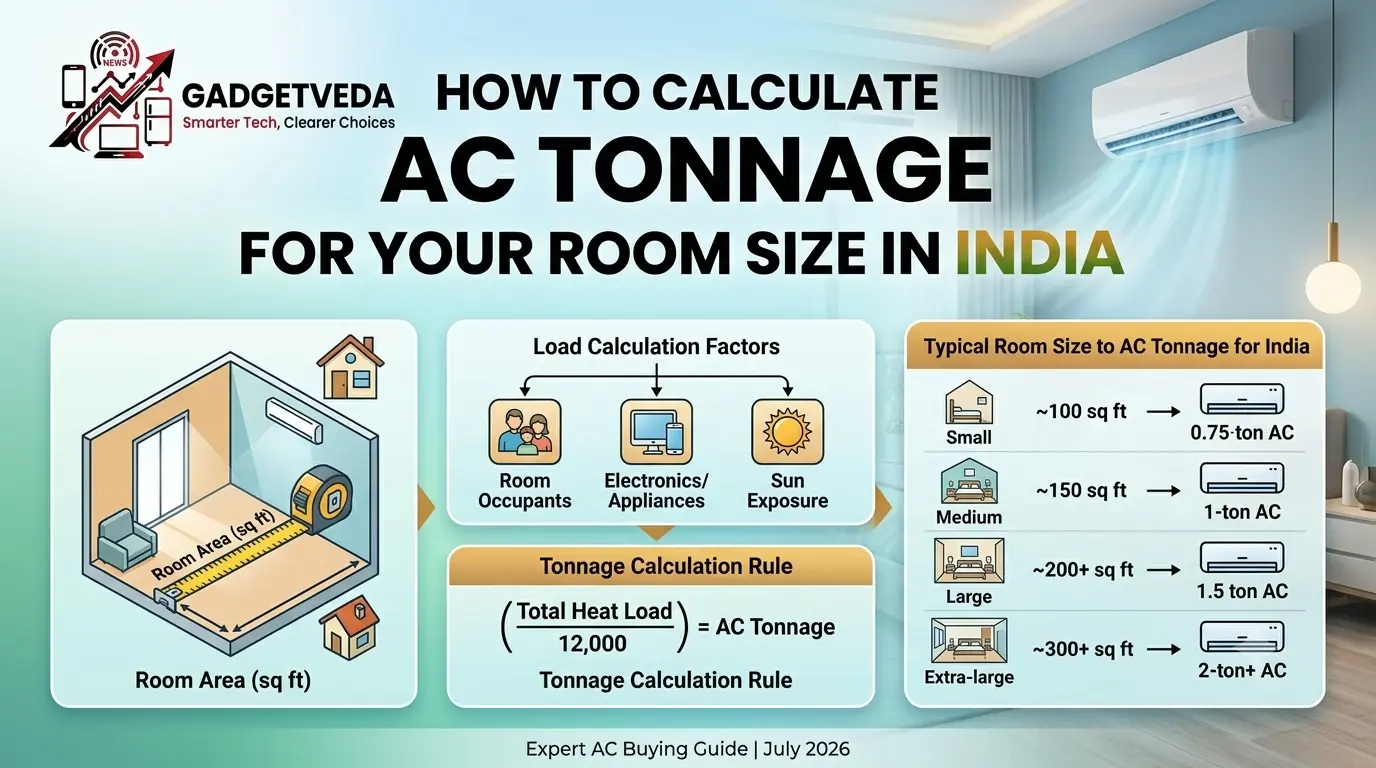
Buying an air conditioner in India without calculating the right tonnage first is one of the most expensive mistakes a buyer can make. Go too small and the AC runs non-stop without ever truly cooling the room. Go too big and you end up with an oversized unit that short-cycles, fails to dehumidify properly, and still drives up your electricity bill.
AC ton calculation is not complicated, but it does require more than a simple sq ft lookup chart. India’s diverse climate zones, high summer temperatures, and varied kitchen and building conditions mean that a formula that works in Delhi NCR may undersize your requirement in Nagpur or Jodhpur. This guide gives you the complete, step-by-step method on how to calculate AC tonnage for your room — with real formulas, adjustment factors, worked examples, and a ready-to-use quick reference table.
What Does “Tonnage” Actually Mean?
Before diving into the calculation, it helps to understand what the term means. In air conditioning, one ton of cooling refers to the ability to remove 12,000 BTU (British Thermal Units) of heat per hour — originally derived from the heat absorbed by one ton of ice melting over 24 hours.
So a 1.5-ton split AC removes 18,000 BTU/hour of heat from your room, and a 2-ton AC removes 24,000 BTU/hour. The higher the tonnage, the more heat the unit can remove per hour — and the faster and more effectively it cools a given space.
This is why AC tonnage calculation is fundamentally about matching the AC’s heat-removal capacity to the heat load of your specific room — not just its floor area.
How to Calculate AC Tonnage for Your Room Size in India (2026 Guide)
Step 1: Measure Your Room Area
Every AC tonnage calculation starts with your room’s floor area. This is straightforward:
Room Area (sq ft) = Length (ft) × Width (ft)
Example: A room that is 14 ft long and 12 ft wide = 168 sq ft
If your room is an irregular shape — for instance, an L-shaped living area — divide it into rectangular sections, calculate each area separately, and add them together for the total floor area.
Step 2: Use the Base Tonnage Formula
Once you have your floor area, you can apply the standard split AC calculation formula used widely across India:
Required Tonnage = Room Area (sq ft) ÷ 120
This formula uses a standard benchmark of 120 BTU per square foot, which is the widely applied rule for Indian residential conditions at standard ceiling height (8–9 ft) and moderate heat load.
Example: 168 sq ft ÷ 120 = 1.4 tons → round up to 1.5-ton AC
Alternatively, the volume method incorporates ceiling height directly:
Required Tonnage = [Length (ft) × Width (ft) × Height (ft)] ÷ 1000
Example: 14 × 12 × 9 = 1,512 ÷ 1,000 = 1.51 tons → 1.5-ton AC
Both methods align well for rooms with standard 8–9 ft ceilings. The volume method becomes more important when the ceiling height is significantly above or below the standard.
Related: Air Conditioner vs Air Cooler: Which Is Better?
Step 3: Apply India-Specific Adjustment Factors
This is where most AC tonnage guides fall short — they stop at Step 2 and hand you a number that works in a lab but not in a real Indian home. The following factors directly affect the heat load your AC needs to handle, and ignoring them leads to real-world underperformance even from a correctly “sized” unit.
🌡️ Factor 1: Ambient Climate and City Temperature
This is the most important India-specific adjustment in AC ton calculation in India. The heat load in a room is directly proportional to the outdoor temperature differential. Cities like Nagpur, Jodhpur, Lucknow, and Hyderabad routinely hit 44–47°C in peak summer — significantly above the standard test conditions used in capacity charts.
A practical adjustment used in Indian HVAC practice:
| Peak Summer Temperature | Tonnage Adjustment |
| Up to 35°C | No adjustment needed |
| 36–40°C | Add ~5–8% to base tonnage |
| 41–45°C | Add ~10–15% to base tonnage |
| Above 45°C | Add ~15–20% to base tonnage |
🪟 Factor 2: Sunlight and Room Orientation
A west-facing or south-facing room absorbs significantly more solar heat through walls and windows, especially in the afternoons when temperatures are highest.
➤ North or east-facing room: No adjustment needed — these receive less direct afternoon sun
➤ South-facing room: Add 10% to base tonnage
➤ West-facing room: Add 15–20% to base tonnage — this is the highest-impact orientation in Indian conditions
🏗️ Factor 3: Ceiling Height
The base formulas assume an 8–9 ft ceiling. For rooms with higher ceilings — common in older construction, heritage properties, or premium apartments — the air volume to be cooled increases meaningfully.
➤ Ceiling up to 9 ft: Standard tonnage
➤ Ceiling 9–11 ft: Add 10% to base tonnage
➤ Ceiling above 11 ft: Add 20%+ and consider a professional load calculation
👨👩👧 Factor 4: Number of Occupants
Every person in a room generates body heat — approximately 400 BTU/hour per person. For the standard two-person assumption built into most charts, no adjustment is needed.
➤ For each additional person beyond 2: Add approximately 0.1 ton to the calculated tonnage
💻 Factor 5: Heat-Generating Appliances
A living room with a large TV, a home office with multiple computers, or a bedroom with a gaming setup all add measurable heat load.
➤ Moderate electronics (TV + set-top box): Add 5%
➤ High electronics density (multiple screens, gaming setups, printer): Add 0.25–0.5 ton
🏠 Factor 6: Floor and Insulation
➤ Ground floor rooms: Generally cooler due to earth contact — standard tonnage is usually sufficient
➤ Top floor rooms: Exposed to roof heat, especially in concrete-slab buildings without ceiling insulation — add 10–15% to base tonnage
Step 4: Apply the Full AC Tonnage Calculation Formula
Putting it all together, the comprehensive how to calculate AC tonnage for room formula for Indian conditions is:
Adjusted Tonnage = Base Tonnage × (1 + Climate factor + Orientation factor + Ceiling factor) + Occupant addition + Appliance addition
Worked Example — Real Indian Home:
➤ Room: 14 ft × 12 ft (168 sq ft), west-facing, top floor
➤ City: Lucknow (peak summer ~44°C)
➤ Ceiling height: 10 ft
➤ Occupants: 3 people regularly
➤ Electronics: Large TV + laptop
Calculation:
➤ Base tonnage: 168 ÷ 120 = 1.4 tons
➤ Climate adjustment (44°C, ~12%): +0.17 ton
➤ West-facing orientation (18%): +0.25 ton
➤ Ceiling height 10 ft (10%): +0.14 ton
➤ 1 extra occupant: +0.1 ton
➤ Moderate electronics (5%): +0.07 ton
Total: ~2.23 tons → Round to 2-ton AC (the standard available size above 1.5 ton)
Without these adjustments, the base formula would have suggested 1.5 tons — likely insufficient for this room through peak summer months.
Quick Reference: AC Tonnage Per Square Foot (India 2026)
This table is a fast lookup for standard Indian rooms at 9 ft ceiling height with moderate heat load:
| Room Size (sq ft) | Base Tonnage | Typical Use Case | Recommended AC |
| Up to 100 sq ft | ~0.8 ton | Small bedroom, study room | 1.0 ton |
| 100–150 sq ft | 1.0–1.25 ton | Standard bedroom | 1.0 or 1.5 ton |
| 150–200 sq ft | 1.25–1.65 ton | Master bedroom, mid-size room | 1.5 ton |
| 200–250 sq ft | 1.65–2.0 ton | Large bedroom, small living room | 1.5 or 2 ton |
| 250–350 sq ft | 2.0–2.9 ton | Living room, large hall | 2 ton |
| 350–500 sq ft | 2.9–4.1 ton | Large hall, open plan area | 2+ ton or dual unit |
ℹ️ For west-facing, top-floor, or high-temperature-city rooms, always round up to the next available size. For shaded, north-facing, or ground-floor rooms in cooler cities, you can stay at the base calculated size.
How to Calculate AC Tonnage for Watts (Power Consumption Check)
Once you’ve determined the right tonnage, you can verify it against wattage to estimate power consumption. The general conversion used in India:
AC Power (Watts) ≈ Tonnage × 1000 W (non-inverter) or × 700–800 W (inverter)
So a 1.5-ton non-inverter AC draws approximately 1,500 W, while a 1.5-ton 5-star inverter AC draws roughly 1,050–1,200 W at full load. This conversion is useful when estimating your monthly electricity bill or calculating whether your home’s wiring and MCB can handle the new AC load.
If your calculated tonnage is between standard sizes (e.g., 1.6 or 1.8 ton), always round up to the next available size (2 ton) rather than down — an undersized AC running continuously is more costly and wears out faster than a correctly or slightly generously sized one.
Why Oversizing Is Just as Harmful as Undersizing
A common Indian buyer tendency is to go “one size up just to be safe.” This sounds logical but causes a real problem: an oversized AC cools the room quickly but shuts off before it can complete the dehumidification cycle, leaving the room feeling cold yet clammy and muggy — especially in humid coastal cities like Mumbai, Chennai, and Kochi.
Research published in energy efficiency literature confirms that oversized AC units can incur meaningful additional energy use due to off-cycle parasitic losses, and that proper load calculation remains the most reliable route to both comfort and energy efficiency. India’s BEE standard for room ACs (ISEER ratings) is also based on correctly sized operation — an oversized unit operating in short-cycle mode delivers less real-world efficiency than its star label suggests.
Bottom line: Calculate, don’t guess. Use the formula above, apply your room’s specific factors, and buy the tonnage that matches your actual heat load — not the one that looks impressive on paper.
Choosing the Right AC After Your Tonnage Calculation
Once you know your required tonnage, the next step is finding a model that delivers it efficiently within your budget. At GadgetVeda, we’ve done the comparison work across every budget range:
💡 GadgetVeda Picks: Best Air Conditioners in India by Budget
Know your tonnage — now find the model that fits your budget:
❄️ Best ACs Under ₹25,000 in India — Entry-level 1-ton and 1.5-ton splits for small rooms and tight budgets
⚡ Best ACs Under ₹30,000 in India — Popular inverter models in 1–1.5 ton with solid BEE star ratings
🌿 Best ACs Under ₹35,000 in India — Strong value 1.5-ton inverter picks with better efficiency and longer compressor warranties
🌟 Best ACs Under ₹40,000 in India — Premium 1.5-ton and entry 2-ton models with high ISEER ratings for larger and hotter rooms
🔝 Best ACs Under ₹50,000 in India — Top-tier inverter ACs with Wi-Fi, 5-star ratings, and advanced features for demanding Indian summers
Conclusion
Getting your AC ton calculation right before purchase is the single most impactful decision you can make for long-term comfort, efficient operation, and lower electricity bills. Start with the base formula — room area ÷ 120 — then systematically apply the adjustment factors for your city’s climate, room orientation, ceiling height, occupancy, and appliances. The additional 10 minutes this takes at the research stage can save you thousands in running costs and prevent years of inadequate cooling.
At GadgetVeda, we believe buying the right AC starts with buying the right size. Use this guide to nail your tonnage, then head to our budget-wise AC recommendations to find the most efficient model for your exact requirement.



![12 Best Earbuds Under ₹3,000 in India [2026] | GadgetVeda](https://gadgetveda.com/wp-content/uploads/2026/09/Best-Earbuds-Under-₹3000-in-India-150x150.webp)
![11 Best Washing Machines Under ₹50,000 in India [2026]](https://gadgetveda.com/wp-content/uploads/2026/09/Best-Washing-Machines-Under-₹50000-in-India-150x150.webp)
![14 Best Wireless Earbuds Under ₹2,000 in India [2026]](https://gadgetveda.com/wp-content/uploads/2026/09/Best-Wireless-Earbuds-Under-₹2000-in-India-150x150.webp)
![10 Best Wireless Earbuds Under ₹1,000 in India [2026]](https://gadgetveda.com/wp-content/uploads/2026/09/Best-Wireless-Earbuds-Under-₹1000-in-India-150x150.webp)


![12 Best Earbuds Under ₹3,000 in India [2026] | GadgetVeda](https://gadgetveda.com/wp-content/uploads/2026/09/Best-Earbuds-Under-₹3000-in-India-300x167.webp)
![11 Best Washing Machines Under ₹50,000 in India [2026]](https://gadgetveda.com/wp-content/uploads/2026/09/Best-Washing-Machines-Under-₹50000-in-India-300x167.webp)
![14 Best Wireless Earbuds Under ₹2,000 in India [2026]](https://gadgetveda.com/wp-content/uploads/2026/09/Best-Wireless-Earbuds-Under-₹2000-in-India-300x167.webp)
![10 Best Wireless Earbuds Under ₹1,000 in India [2026]](https://gadgetveda.com/wp-content/uploads/2026/09/Best-Wireless-Earbuds-Under-₹1000-in-India-300x167.webp)