


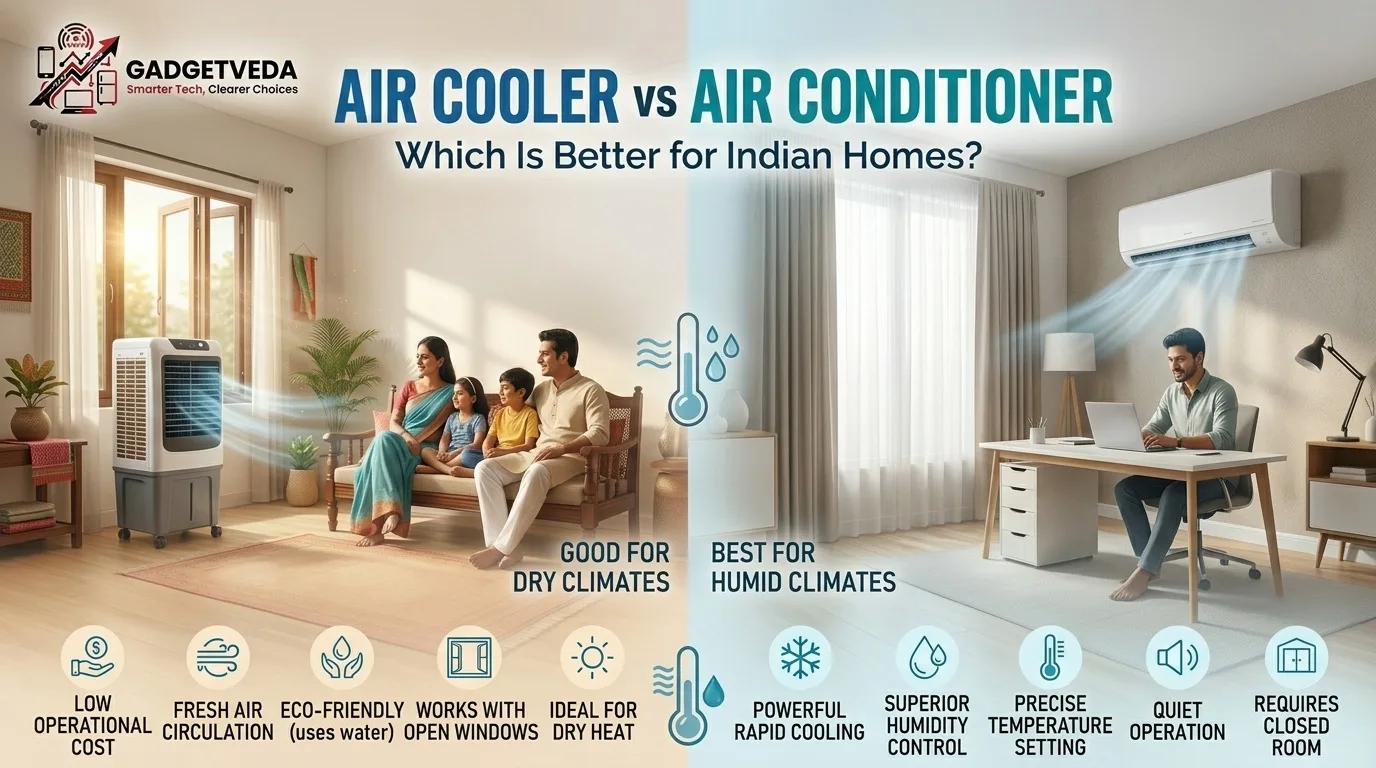
Indian summers are getting harsher, and both air coolers and air conditioners are selling in record numbers — India now buys well over 10 million AC units a year, yet only around 8–10% of households currently have an air conditioner at home. For most families, the real question isn’t “which is best in theory?”, but “which makes sense for my climate, my budget, and my electricity bill?” An air cooler can be incredibly efficient in the right conditions, while an AC can feel non‑negotiable in hot and humid metros.
At GadgetVeda, we see both devices as tools with different strengths, not rivals in a popularity contest. In this article, we break down air cooler vs air conditioner with an Indian lens: climate suitability, electricity consumption, environmental impact, upfront and running costs, and who should choose what.
Air Cooler vs AC [Quick Snapshot]
| Factor | Air Cooler (Evaporative) | Air Conditioner (Refrigerant) |
| Cooling Method | Uses evaporation: pulls hot air through water‑soaked pads and blows out cooler, more humid air. | Uses vapor‑compression refrigeration to remove heat from indoor air and expel it outdoors in a closed loop. |
| Best Climate | Hot, dry climates with low humidity (North & West interiors, dry inland cities). | Works in all climates, especially hot & humid coastal and metro regions. |
| Humidity Effect | Adds moisture to the air; can feel uncomfortable in already humid conditions | Removes moisture (dehumidifies), crucial for muggy coastal climates. |
| Energy Use | Typically, 60–90% less electricity than comparable AC cooling capacity. | Uses much more power; even efficient split ACs draw roughly 1–1.5 units per hour in real‑world use. |
| Monthly Running Cost (Example) | Indian cost breakdowns show that a cooler running ~12 hours/day can cost around ₹1,000 per month in electricity. | The same scenario with an AC can cross ₹2,100 per month, more than double the cooler’s running cost. |
| Upfront Cost | Low to moderate purchase price; no major installation cost. | Higher device cost plus professional installation and, often, a stabilizer. |
| Environmental Impact | No refrigerants; can cut energy use and CO₂ emissions by up to 80–90% vs traditional ACs in suitable climates. | Uses refrigerants with a global warming potential and much higher electricity, so the overall carbon footprint is higher. |
| Comfort Level | Feels like a strong, cool breeze; room temperature is usually a few to several degrees lower, best with ventilation. | Precise temperature control (India now mandates a default of 24 °C) and stable comfort even at extreme heat. |
| Installation & Portability | Plug‑and‑play; easy to move between rooms or floors. | Fixed installation (window or split); not portable. |
| Ideal Users | Budget‑conscious households, renters, dry‑climate cities, and areas with frequent power cuts. | Families in hot‑humid metros, allergy‑prone users, and WFH professionals need stable cooling. |
Related: Air Cooler Capacity Guide: How to Choose an Air Cooler by Room Size?
Air Cooler vs Air Conditioner: How Each Technology Works?
How Does an Air Cooler Work?
An air cooler uses the simple physics of evaporative cooling. Warm room air is pulled in by a fan, passed through water‑saturated cooling pads, and as the water evaporates, it absorbs heat from the air before blowing it back into the room, which is cooler and more humid. The drier the incoming air, the more efficiently this process works, because dry air can absorb more moisture and heat during evaporation.
How Does an Air Conditioner Work?
An air conditioner uses a closed refrigerant loop: refrigerant circulates between indoor and outdoor units, absorbing heat from indoor air at the evaporator and rejecting it outside via the condenser. The system also condenses and drains out moisture from the indoor air, which is why ACs both cool and dehumidify — a key advantage in humid parts of India.
Air Cooler vs Air Conditioner [Detailed Comparison]
Cooling Performance and Comfort
In real use, air coolers and ACs feel very different even if a thermometer shows similar numbers. In hot, dry conditions with good cross‑ventilation, an air cooler can lower effective indoor temperature by roughly 5–15 °C, though the actual drop depends heavily on outdoor temperature and humidity. The air stream feels breezy and slightly moist, which many people find pleasant in dry regions but sticky in coastal cities.
Air conditioners — especially inverter split units — provide precise, stable cooling. You set a target temperature (with a default of 24 °C now mandated for room ACs in India), and the system works to maintain it regardless of humidity. In heatwave conditions with temperatures pushing 45 °C, an AC can keep a closed room much cooler and more consistent than an air cooler, particularly when humidity spikes before and during the monsoon.
From a pure comfort standpoint:
➤ In moderate to very dry heat, a correctly sized cooler can feel surprisingly comfortable for day‑to‑day use.
➤ In humid or extremely hot conditions, an AC will generally deliver a more controlled, fatigue‑free environment, especially for sleep and long work sessions.
💡 GadgetVeda Recommends: Best Air Coolers in India by Budget
Not sure which model fits your budget? We’ve handpicked the top-rated air coolers across every price range — skip the research, find your match.
🏆 Best Air Coolers Under ₹5,000 in India— Maximum value, trusted brands, solid cooling for small bedrooms
⚡ Best Air Coolers Under ₹6,000 in India— Better tank capacity and airflow, the sweet spot for most Indian homes
🌬️ Best Air Coolers Under ₹7,000 in India— Where desert coolers get seriously good with stronger CFM and better pads
💨 Best Air Coolers Under ₹8,000 in India— High-capacity models with improved build, auto-fill, and multi-speed control
🔝 Best Air Coolers Under ₹10,000 in India— Premium picks with large tanks, powerful air throw, and durable bodies for large rooms
🌟 Best Air Coolers Under ₹12,000 in India— Top-tier performance, smart features, and heavy-duty cooling for demanding Indian summers
Energy Use and Running Cost
This is where the difference becomes dramatic for many Indian homes.
Multiple technical comparisons show that evaporative cooling systems (air coolers) can use around 80–90% less electricity than conventional refrigerant‑based air conditioning for similar cooling duties. Industrial data even indicates that advanced evaporative systems may operate on only 10–20% of the energy of comparable AC systems, translating into up to 90% lower CO₂ emissions in compatible climates.
On the residential side, Indian cost breakdowns quantify this gap:
➤ A typical residential cooler consuming around 150–400 W and running about 12 hours a day can cost roughly ₹1,000 per month in electricity at common tariffs.
A 1.5‑ton, 5‑star inverter AC drawing in the range of 800–1,050 W over the same schedule can push monthly consumption to around 300 units, often exceeding ₹2,100 per month, more than double the cooler’s bill.
➤ India’s BEE star labeling program has tightened minimum efficiency standards so that split ACs at the 5‑star level are now over 60% more efficient than the baseline models of a decade ago. For example, one manufacturer comparison cites a 1.6‑ton 3‑star split AC using roughly 1.4 units per hour, whereas a 5‑star equivalent could be closer to 1.1 units per hour, resulting in meaningful savings over its lifespan. Even so, ACs remain far more energy‑hungry than coolers in absolute terms.
Bottom line on running cost:
➤ If your electricity bill is a primary constraint, air coolers win by a wide margin.
➤ If you are willing to pay higher monthly costs for all‑weather, sealed‑room comfort, an energy‑efficient inverter AC (preferably 4–5 star) is justified.
Related: Air Cooler Market in India
AC vs Air Cooler: Which Is More Eco‑Friendly?
From an environmental standpoint, air coolers are generally the greener choice in climates where they work well.
Evaporative coolers use water — effectively a natural refrigerant — instead of synthetic refrigerants like HFCs, which contribute to global warming when leaked. Studies and manufacturer data indicate that evaporative cooling can reduce energy use by around 75–80%, leading to up to 86–90% lower CO₂ emissions compared with traditional AC systems providing similar cooling in suitable conditions.
There is a common concern that air coolers “waste water,” but when you factor in the water needed to generate electricity for ACs, the picture shifts. One engineering analysis found that once you include the water footprint of power generation, an evaporative cooling system can use up to 30% less total water than a conventional AC system.
ACs, on the other hand:
➤ Consume substantially more electricity overall, and in India, more than 70–75% of summer grid power still comes from coal, directly adding to greenhouse gas emissions and urban heat.
➤ Use refrigerants with non‑zero global warming potential, even as the industry moves from older CFC/HCFCs to relatively less harmful HFCs and other blends.
India is trying to mitigate this through stricter BEE standards and mandatory default temperature settings, improving the minimum efficiency of split ACs by more than 40% at the entry star level and over 60% at the top star level over recent revisions. This helps, but it does not fully close the environmental gap in regions where air coolers can provide adequate comfort.
In summary:
➤ In dry climates, air coolers are generally far more environmentally friendly for each unit of comfort delivered.
➤ In humid climates, ACs may be the only practical option for health and productivity, so choosing high‑efficiency, high‑star models becomes the “less harmful” path rather than a perfect solution.
💡 GadgetVeda Recommends: Best Air Conditioners in India by Budget
Looking for the right AC within your budget? We’ve shortlisted the best options across price tiers — efficient, reliable, and value-driven picks so you can buy with confidence.
❄️ Best ACs Under ₹25,000 in India— Entry-level split and window ACs that balance price and seasonal efficiency for small rooms
🌟 Best ACs Under ₹28,000 in India— Slightly higher capacity/efficiency; good for single bedrooms and moderate cooling needs
⚡ Best ACs Under ₹30,000 in India— Popular budget inverter options and reliable 1‑ton splits for better energy use
🔧 Best ACs Under ₹35,000 in India— Strong value for 1‑ and 1.5‑ton models with improved compressors and longer warranties
🌿 Best ACs Under ₹40,000 in India— Efficient inverter ACs with higher BEE star ratings and better dehumidification for coastal regions
🔝 Best ACs Under ₹50,000 in India— Premium value tier: high‑efficiency inverter models, smart features, and superior longevity
Climate Suitability: Dry vs Humid India
Air Cooler vs AC in Dry Climates
In hot‑dry regions — much of Rajasthan, interior Gujarat, parts of Delhi‑NCR, and central India during peak summer — air coolers can perform extremely well. Evaporation is efficient because the ambient air has the capacity to absorb more moisture, so you get a significant temperature drop and pleasant humidity at a low running cost.
In these conditions:
➤ A properly sized desert or tower cooler can comfortably handle bedrooms and medium‑sized halls when used with cross‑ventilation.
➤ ACs still provide better performance in sealed, glass‑heavy, or top‑floor west‑facing rooms, but many households find coolers “good enough” for most of the season and use ACs only on extreme days or for night sleep.
Air Cooler vs AC in Humid Regions
In humid regions — coastal Maharashtra and Karnataka, Kerala, much of West Bengal and Odisha, and even many cities during the monsoon — the story changes. The air is already moisture‑laden, so adding more humidity (which is what coolers do) can make rooms feel hotter and stickier instead of more comfortable.
Air coolers in high humidity:
➤ Show reduced effective temperature drop because evaporation slows down when the air is already moist.
➤ Can make indoor air feel muggy unless used with very strong ventilation, and even then, results can be hit‑or‑miss.
Air conditioners in high humidity:
➤ Dehumidify while cooling, which is often more important for comfort than the raw temperature reading.
➤ They are widely recommended for coastal and muggy climates because they address both temperature and perceived stickiness.
So, if you live in Mumbai, Chennai, Kochi, Kolkata, or similar climates, an AC — ideally an efficient inverter model — will generally outperform a cooler for overall comfort, especially during and around the monsoon months.
Related: Types of Air Coolers – Desert, Tower, & Window Coolers
Upfront Cost, Maintenance, and Lifespan
Upfront Cost and Installation
➤ Air coolers have low to moderate purchase prices and require no professional installation — you plug them in, fill the tank, and ensure ventilation.
➤ ACs cost several times more upfront and usually require professional installation, mounting hardware, possible civil work, and often a stabilizer depending on your local power quality.
For renters, the ability to move a cooler to a new house without leaving anything behind is a big practical plus.
Maintenance Effort
➤ Air coolers need regular cleaning of the tank, pads, and fan area, plus periodic pad replacement — simple DIY tasks if you follow basic hygiene steps.
➤ ACs need professional servicing, including cleaning indoor and outdoor units, checking refrigerant levels, washing or replacing filters, and occasionally repairing electronics or compressor parts.
Neglecting maintenance hurts performance and energy efficiency for both, but cooler care is cheaper and easier to manage on your own.
Lifespan
With normal care, both coolers and ACs can last several years. ACs are capital goods designed for long life, but out‑of‑warranty repairs (compressor replacement, gas leak fixes, PCB failures) can be expensive. Coolers are cheaper to repair or replace, though very low‑end models may not be as durable as premium metal‑body or top‑brand units.
Air Cooler vs Air Conditioner: Who Should Choose What?
Bringing it all together for different Indian user profiles:
Choose an Air Cooler if…
➤ You live in a hot‑dry region for most of the summer.
➤ Your budget is limited, and electricity bills are a major concern.
➤ You need a portable solution where you can move between rooms or different rental homes.
➤ You’re okay with a strong, breezy cooling effect instead of sealed‑room AC‑like chill.
Choose an Air Conditioner if…
➤ You live in a humid or coastal region where coolers underperform or feel muggy.
➤ You have small children, an elderly family member, or health conditions that require stable indoor conditions in peak summer.
➤ You work from home and need consistent, controlled cooling for long hours.
➤ You can afford both a higher upfront cost and higher monthly electricity bills, and you’re willing to choose 4–5 star BEE‑rated inverter models for better efficiency.
Mixed Strategy (Very Common in Indian Homes)
➤ Use a high‑efficiency AC in the main bedroom for night‑time comfort and the most critical hours.
➤ Use air coolers in secondary bedrooms or living areas where absolute temperature precision is less critical.
Conclusion: No One‑Size‑Fits‑All Answer — and That’s Okay
There is no universal winner in the air cooler vs air conditioner debate — only the right choice for your climate, your budget, and your comfort expectations. In dry parts of India, a well‑chosen air cooler delivers impressive comfort at a fraction of the cost and environmental impact of an AC. In humid, coastal, or extremely hot urban environments, a good inverter AC with a solid BEE star rating is often the only practical way to stay healthy and productive through long summers.At GadgetVeda, we recommend you first decide which technology fits your lifestyle, then drill down into the right capacity and budget bracket. When you’re ready, head over to our best air coolers under budget and best ACs under budget series to shortlist real models that fit this framework — so you’re not just buying a product, you’re choosing the right cooling strategy for your home.




![OnePlus Nord Buds 4 Review [Price, ANC & Battery Verdict]](https://gadgetveda.com/wp-content/uploads/2026/10/OnePlus-Nord-Buds-4-Review-GadgetVeda-150x150.webp)

![5 Best Smart TVs Under ₹15,000 in India [2026]](https://gadgetveda.com/wp-content/uploads/2026/10/Best-Smart-TVs-Under-₹15000-in-India-150x150.webp)



![OnePlus Nord Buds 4 Review [Price, ANC & Battery Verdict]](https://gadgetveda.com/wp-content/uploads/2026/10/OnePlus-Nord-Buds-4-Review-GadgetVeda-300x167.webp)

![5 Best Smart TVs Under ₹15,000 in India [2026]](https://gadgetveda.com/wp-content/uploads/2026/10/Best-Smart-TVs-Under-₹15000-in-India-300x167.webp)