


![Air Cooler Capacity Guide How to Choose the Right Size for Your Room [2026]](https://gadgetveda.com/wp-content/uploads/2026/05/Air-Cooler-Capacity-Guide-How-to-Choose-the-Right-Size-for-Your-Room-2026.webp)
If you are shopping for an air cooler this summer, capacity is the single most important spec you need to get right—especially in Indian conditions where room sizes, ceiling heights, and climate vary widely across regions. Choose too small, and your cooler will just push lukewarm air around; choose too big, and you waste money, water, and electricity without getting proportionately better comfort. What makes this decision even trickier is that most product pages bury the key specs under marketing language.
At GadgetVeda, our goal is to cut through the noise and translate technical jargon—CFM, CMH, tank capacity, BIS standards—into clear, actionable guidance for your home. And the timing matters: the Indian air cooler market reached ₹126.1 billion in 2025 and is projected to grow at a CAGR of 6.81% through 2034, which means more models, more choices, and more room for confusion if you don’t know what to look for.
In this 2026 guide, we walk you through 12 key factors to match air cooler capacity to your room size, using practical rules, real Indian room size examples, and verified benchmarks from brands, BIS, and BEE. Whether you need a compact personal cooler for a 10×12 bedroom or a heavy-duty desert cooler for a large hall, by the end of this discussion, you’ll know exactly what to buy—and why.
How to Choose the Right Size for Your Room [12 Key Factors]
1. Start With Your Room Measurements
Every capacity decision begins with one simple step: measure your room before calculating air cooler capacity for room size. You need at a minimum your room’s length and width in feet to calculate the area in square feet (sq ft). If you also measure the ceiling height, you can calculate the room’s volume in cubic meters (m³)—which is what most precise capacity formulas actually use.
Here’s the quick formula:
Room volume (m³) = Length (ft) × Width (ft) × Height (ft) × 0.028
In India, a standard bedroom typically falls between 132–244 sq ft, with common layouts like 12′×12′ or 13′×16′. Many urban apartment bedrooms sit in the 90–150 sq ft range, while master bedrooms in independent homes can exceed 200 sq ft. Don’t skip this step—even a 30-second tape measure exercise directly determines whether your summer nights are comfortable or sweaty.
💡 GadgetVeda Picks — Budget Air Coolers
Looking for a capable air cooler on a tight budget? We’ve reviewed the best options, so you don’t have to compromise on airflow or build quality. Check out our curated features below:
👉 Best Air Coolers Under ₹5,000 in India — The most reliable picks for small bedrooms and personal use, delivering solid CFM without burning a hole in your pocket.
👉 Best Air Coolers Under ₹6,000 in India — Step up your cooling game with more airflow, better tank capacity, and smarter features — all within the ₹6K mark.
2. Understand Air Delivery: CFM and CMH Explained
On an air cooler’s spec sheet, you’ll see air delivery rated in either CFM (cubic feet per minute) or CMH (cubic meters per hour). This tells you how much air the cooler can push through your room per unit time—and it is the single most critical number for matching a cooler to your room size, making it one of the important factors to consider if you want to know how to choose air cooler size for room.
A practical benchmark for direct evaporative coolers is targeting approximately 20–30 air changes per hour. Using 30 as the standard, the required air delivery formula becomes:
Required air delivery (m³/h) = Room volume (m³) × 30
For example, a 12′×10′×10′ room has a volume of roughly 33.6 m³, meaning you’d need a cooler delivering at least ~1,000 m³/h for meaningful cooling. As a simpler room-area-to-CFM guide used by Indian retail and rental platforms:
🟢 Up to 150 sq ft → approximately 1,000–2,000 CFM
🟡 150–250 sq ft → approximately 2,000–3,000 CFM
Always check the air delivery figure on the spec sheet—not just the tank size or a brand’s vague “suitable for X sq ft” claim, which is often based on ideal conditions the manufacturer sets.
3. Match Cooler Type to Your Room Size and Climate
Not all air coolers are built the same. Picking the right type of cooler is as important as picking the right capacity number, because different designs are optimized for different room sizes and humidity conditions.
🏠 Personal/Tower coolers — Best for small bedrooms and personal spaces up to about 120–150 sq ft. They are compact, relatively quiet, and designed for close-proximity use.
☀️ Desert coolers — Built for large rooms, open halls, and dry climates. They handle higher volumes of air, carry larger tanks, and deliver stronger airflow for spaces above 200 sq ft.
🪟 Window coolers — Mounted into a wall opening, they draw fresh outdoor air directly and suit medium to large rooms while freeing up floor space.
If you live in states like Rajasthan, Punjab, Haryana, or interior Uttar Pradesh, where summers are consistently hot and dry, a desert cooler is your best bet—it thrives in low-humidity conditions and handles larger spaces effectively. In more humid coastal or eastern states, prioritize airflow strength and ensure cross-ventilation; temperature drop expectations need to be realistic, but a correctly sized cooler still meaningfully improves comfort.
4. Use Practical Room Size–Capacity Benchmarks
Theory is only useful when it translates into a decision. Here’s a reference table based on typical Indian homes, brand recommendations, and rental guides—assuming standard ceiling height (~9–10 ft) and decent ventilation:
| Approx. Room Size | Typical Indian Example | Suggested Air Delivery | Likely Cooler Type |
| Up to ~120 sq ft | Small bedroom, study, home office nook | ~800–1,400 m³/h (~1,000–2,000 CFM) | Personal / tower cooler |
| 120–200 sq ft | Standard bedroom, small drawing room | ~1,400–2,200 m³/h (~2,000–3,000 CFM) | Larger tower or compact desert cooler |
| 200–300 sq ft | Master bedroom, medium hall | Above 2,200 m³/h (3,000+ CFM) | Desert or window cooler |
| Above 300 sq ft | Large hall, shop, open living space | High-capacity desert cooler | Desert cooler (multiple units if needed) |
These are starting benchmarks, not rigid rules. Room orientation, ceiling height, furniture density, and occupancy can all push your ideal choice up a notch, which the following factors address.
5. Account for Ceiling Height, Layout, and Furniture
Standard capacity charts assume a ceiling height of around 9–10 feet. If your room has a higher ceiling—say 12 feet or above, common in older bungalows or newer premium apartments—the actual air volume is significantly larger, and you will likely need a higher-capacity cooler than a basic sq-ft chart suggests.
Furniture density matters too. A room packed with wardrobes, beds, partitions, and shelving reduces the space for free airflow and can create dead zones where you barely feel the breeze. In such cases:
⬆️ Choose a cooler towards the upper end of the recommended CFM/CMH range for your room size.
📍 Strategically position the cooler so it throws air directly towards where you sit or sleep, rather than into a wall or blocked corner.
If your bedroom sits in the typical Indian range of 132–244 sq ft but has a high ceiling or heavy furniture, it is almost always smarter to size up slightly rather than pick the bare minimum listed on the box.
6. Know Your Climate: Humidity and Realistic Temperature Drop
Here is the physics in plain language: evaporative coolers work by pulling hot air through water-soaked pads. As water evaporates, it absorbs heat from the air, and the fan throws out the cooled air into your room. The drier the incoming air, the more efficient this evaporation, which is why desert coolers dominate sales in arid regions of North and Central India.
In ideal dry conditions (20–40% relative humidity), a well-sized air cooler can reduce indoor temperatures by 5–15°C. In already-humid conditions, expect a smaller temperature reduction—but a properly sized cooler still provides meaningful relief through strong airflow and a few degrees of effective cooling.
If you live in a humid region, here’s your practical playbook:
💨 Prioritize high air delivery (strong CFM/CMH) over maximum tank size.
🔄 Ensure proper cross-ventilation
✅ Set realistic expectations—you’re boosting comfort and air movement, not replicating AC-level cooling.
👉 Related: Air Cooler Market Size in India
7. Tank Capacity and Runtime: Convenience, Not a Capacity Substitute
Water tank size directly determines how long your cooler runs before the next refill—a real concern for Indian households dealing with overnight comfort and frequent power cuts. A small tank in a large room means constant trips to the tap.
As a practical guide:
🪣 Rooms under 150 sq ft: A tank of 20–30 liters is usually sufficient alongside appropriate air delivery.
🛢️ Rooms above 200 sq ft: Scale up to 40–70+ liter tanks to avoid constant refills during long use sessions.
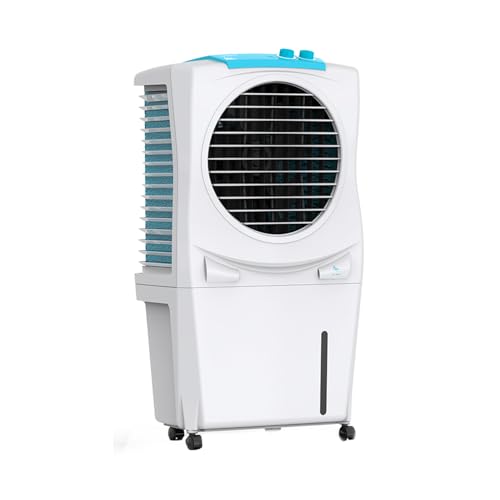

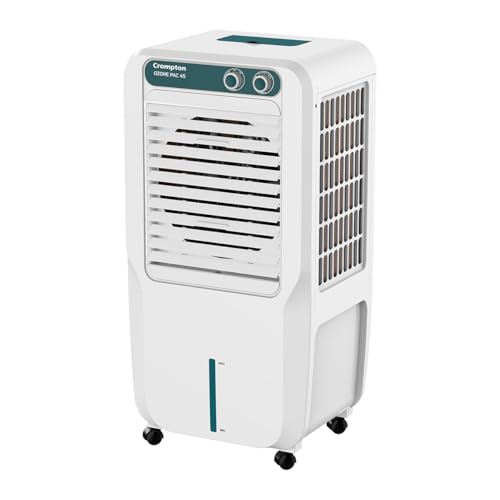
However—and this is critical—a bigger tank does not mean a more powerful cooler. A 70-liter desert cooler with poor air delivery will still fail to cool a large hall effectively. Always evaluate tank size alongside the CFM/CMH rating, not instead of it. Think of tank capacity as a runtime convenience feature that should scale with your room size and usage hours—not a substitute for correct airflow calculations.
8. Ventilation, Placement, and Air Path: The Often-Ignored Factor
You can buy the perfectly spec-matched cooler and still be disappointed—if your room doesn’t have the right airflow path. Because evaporative coolers add moisture to the air as they cool it, they work best with cross-ventilation: hot, dry air enters from one side, passes through the cooler, gets cooled, and exits from the opposite side.
Key placement rules that brands and experts consistently stress:
🚪 Keep a door or window partially open to let stale, humid air escape. Running a cooler in a sealed room makes the air progressively more humid and kills cooling effectiveness rapidly.
🌿 Position the cooler so it can draw fresh outdoor air rather than recirculating already-humid indoor air.
🎯 In large halls, direct the airflow towards occupied zones—where people sit or sleep—rather than into corners or empty areas.
Poor ventilation can make even the best-spec’d cooler feel underwhelming. When planning your cooler capacity, mentally plan your room’s airflow path at the same time—it’s half the battle.
9. Check BIS (IS 3315:2024) Compliance and BEE Star Ratings
From 2024 onwards, direct evaporative air coolers in India are governed by Indian Standard IS 3315:2024, which defines mandatory quality parameters covering air delivery, cooling efficiency, power consumption, noise levels, cooling pad quality, electrical safety, sump capacity, and durability testing. The Bureau of Indian Standards (BIS) tests products before granting the ISI mark and continues surveillance testing after the license is granted.
In parallel, the Bureau of Energy Efficiency (BEE) operates a Standards & Labeling (S&L) program for evaporative air coolers, with the star rating table’s validity extended under a voluntary regime until 30 June 2027. Manufacturers must upload updated documents and revised sample labels to keep their models active under BEE registration.
As a buyer, here’s what this means practically:
🏅 Look for the BIS ISI mark (IS 3315:2024 compliant) as a baseline quality and safety signal.
⭐ Prefer higher BEE star-rated models when buying higher-capacity coolers—more stars generally mean better energy efficiency for the same cooling output, directly impacting your electricity bills over long summer months.
This is especially important if you’re upsizing to a desert cooler for a mid-sized room—you want the extra airflow without a disproportionate spike in power consumption.
10. Factor In Heat Load: Occupancy, Sunlight, and Electronics
Room size alone doesn’t tell the whole story. Your room’s actual heat load—how much heat builds up during real use—determines how hard your cooler has to work. Cooling equipment professionals account for this when sizing any cooling system, and the same logic applies to air coolers.
Consider upsizing within your capacity range if any of the following apply:
🌅 The room is west-facing, on the top floor, or has large windows with direct afternoon sun—these rooms heat up significantly faster and retain heat longer.
👨👩👧 The room regularly has multiple occupants (a family bedroom, shared living space, or home office), each of whom generates body heat.
📺 You regularly run heat-generating electronics—TVs, gaming consoles, multiple computers—especially in a compact room.
A practical buffer to keep in mind: add roughly 20% to your calculated capacity requirement for top-floor rooms or spaces with significant direct sun exposure. In contrast, a shaded, lightly occupied bedroom of standard size can be perfectly well-served by a compact tower cooler with moderate air delivery—as long as ventilation is handled properly.
11. Don’t Oversize or Undersize — Balance Is Everything
Finally, resist the temptation to think “bigger is always better.” This is a common and costly mistake, and one that AC sizing experts in India specifically warn against for any cooling system. Here’s what actually happens at both extremes:
❌ Under-sized cooler: Struggles to circulate adequate air volume for your room, delivering a barely noticeable temperature drop on peak summer afternoons—even when running at full blast all day.
⚠️ Oversized cooler: Costs more upfront, draws more power, runs louder, and—if ventilation isn’t properly managed—can make the room feel muggy rather than cool by over-humidifying the indoor air.
The ideal cooler is one whose air delivery matches your room’s volume and real-world heat load, has a tank size that suits your usage hours, and is backed by BIS compliance and a solid BEE star rating. It’s not necessarily the most expensive model in the store. By systematically working through the 10 factors above, you can arrive at this balance with confidence—not guesswork.
💡 GadgetVeda Picks — Mid-Range Air Coolers
👉 Best Air Coolers Under ₹7,000 in India — Great value desert and tower coolers with meaningful upgrades over budget picks — ideal for standard Indian bedrooms.
👉 Best Air Coolers Under ₹8,000 in India — Our top picks at this sweet-spot price — strong airflow, durable build, and BIS-compliant models worth every rupee.
👉 Best Air Coolers Under ₹10,000 in India — The best of the best under 10K — high-capacity desert coolers and premium tower models for large rooms, top floors, and whole-family use.
12. Air Cooler Size Table: Find the Right Capacity for Your Room
📐 By Room Area (Square Feet)
| Room Size (sq ft) | Room Type (Indian Context) | Min. Air Delivery | Tank Capacity | Cooler Type |
| Up to 80 sq ft | Small study, single pooja room, compact cabin | ~500–800 m³/h | 15–20 L | Personal cooler |
| 80–120 sq ft | Small bedroom, 1-person office | ~800–1,200 m³/h | 20–25 L | Personal/small tower cooler |
| 120–150 sq ft | Standard bedroom, kitchen, and dining | ~1,000–1,500 m³/h | 25–30 L | Tower or mid-size personal cooler |
| 150–200 sq ft | Large bedroom, small drawing room | ~1,500–2,000 m³/h | 30–40 L | Tower or compact desert cooler |
| 200–300 sq ft | Master bedroom, medium living room | ~2,000–3,000 m³/h | 40–55 L | Desert or window cooler |
| 300–450 sq ft | Large hall, open living + dining | ~3,000–4,500 m³/h | 55–75 L | High-capacity desert cooler |
| 450–600 sq ft | Shop, large community hall, farmhouse room | ~4,500–6,000 m³/h | 75–100 L | Industrial/commercial desert cooler |
📏 By Room Dimensions (Common Indian Layouts)
| Room Dimensions | Area (sq ft) | Volume (m³) @ 10 ft ceiling | Ideal Air Delivery (m³/h) | Tank Size | Cooler Type |
| 8′ × 10′ | 80 sq ft | ~22.4 m³ | ~670 m³/h | 15–20 L | Personal cooler |
| 10′ × 12′ | 120 sq ft | ~33.6 m³ | ~1,000 m³/h | 20–30 L | Personal / tower cooler |
| 12′ × 12′ | 144 sq ft | ~40.3 m³ | ~1,200 m³/h | 25–30 L | Tower cooler |
| 12′ × 15′ | 180 sq ft | ~50.4 m³ | ~1,500 m³/h | 30–40 L | Tower or compact desert |
| 14′ × 16′ | 224 sq ft | ~62.7 m³ | ~1,880 m³/h | 40–50 L | Desert or window cooler |
| 16′ × 18′ | 288 sq ft | ~80.6 m³ | ~2,420 m³/h | 50–60 L | Desert cooler |
| 18′ × 20′ | 360 sq ft | ~100.8 m³ | ~3,024 m³/h | 65–80 L | High-capacity desert cooler |
| 20′ × 25′ | 500 sq ft | ~140 m³ | ~4,200 m³/h | 80–100 L | Industrial desert cooler |
Conclusion
Choosing the right air cooler capacity for your room size comes down to one thing: knowing your room and respecting the numbers. Measure your space, understand what CFM and CMH mean for your room’s actual volume, pick the right cooler type for your climate, and layer in real-world adjustments for ceiling height, heat load, and ventilation. With India’s air cooler market expanding rapidly and shelves stocking more models than ever, the right framework separates a summer of comfortable, cost-effective cooling from months of buyer’s regret.
At GadgetVeda, we’ve done the heavy lifting for your next step. Check out our curated guide to the best air coolers in India by budget range—where we apply exactly this capacity framework to handpick the top models across every price bracket, so you can match your ideal capacity band to a real product in minutes.
Ready to invest a little more for noticeably better cooling? The ₹7,000–₹10,000 range is where Indian air coolers genuinely shine — larger tanks, higher CMH ratings, and desert cooler performance for mid-sized rooms.




![OnePlus Nord Buds 4 Review [Price, ANC & Battery Verdict]](https://gadgetveda.com/wp-content/uploads/2026/10/OnePlus-Nord-Buds-4-Review-GadgetVeda-150x150.webp)

![5 Best Smart TVs Under ₹15,000 in India [2026]](https://gadgetveda.com/wp-content/uploads/2026/10/Best-Smart-TVs-Under-₹15000-in-India-150x150.webp)



![OnePlus Nord Buds 4 Review [Price, ANC & Battery Verdict]](https://gadgetveda.com/wp-content/uploads/2026/10/OnePlus-Nord-Buds-4-Review-GadgetVeda-300x167.webp)

![5 Best Smart TVs Under ₹15,000 in India [2026]](https://gadgetveda.com/wp-content/uploads/2026/10/Best-Smart-TVs-Under-₹15000-in-India-300x167.webp)