


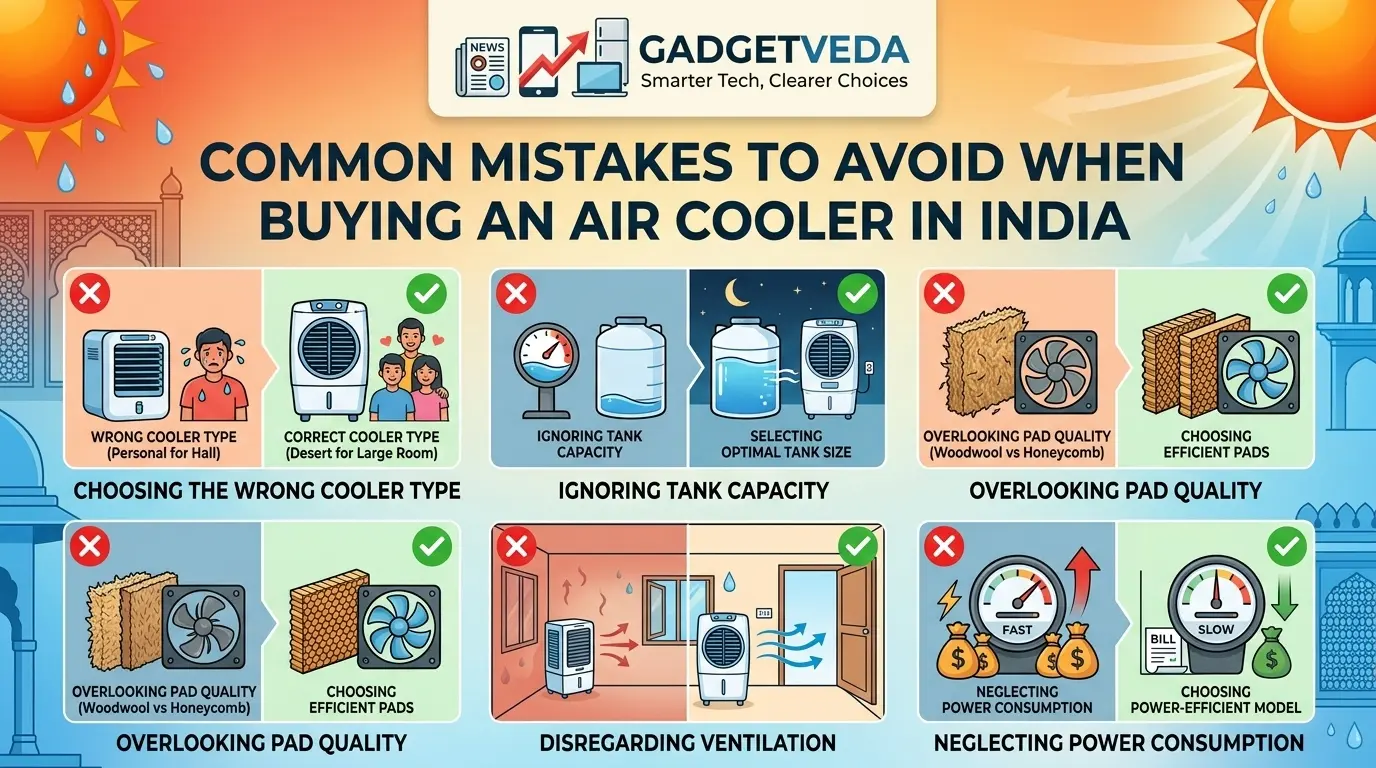
Every summer, millions of Indian households rush to buy an air cooler — and every summer, thousands of those buyers end up dissatisfied. The cooler either doesn’t cool enough, runs out of water by midnight, trips the power, or starts smelling within weeks. Almost all of these problems are avoidable if you know what to look for before the purchase.
India’s air cooler market reached ₹126.1 billion in 2025 and is projected to nearly double to ₹235.1 billion by 2034 — growing at a steady CAGR of 6.81%. With millions of new buyers entering the market every year, particularly in tier-2 and tier-3 cities, the room for costly mistakes is enormous. At GadgetVeda, we’ve tracked the most common patterns — and this guide exists so you don’t have to learn them the hard way.
Here are the 10 most common air cooler buying mistakes in India, and exactly what to do instead.
🛒 Also Explore: Best Air Coolers in India by Budget
Before you dive in — if you already know your budget range, jump straight to our curated picks:
➡️ Best Air Coolers Under ₹5,000 in India — Small room air coolers for PG students and compact bedrooms
➡️ Best Air Coolers Under ₹6,000 in India — Personal and tower coolers for small rooms; ideal for single users, students, and compact bedrooms
➡️ Best Air Coolers Under ₹7,000 in India — Compact desert coolers with decent tank capacity; good for small families in dry-climate cities
➡️ Best Air Coolers Under ₹8,000 in India — Mid-range picks with larger tanks and better air throw; the sweet spot for most Indian bedrooms
➡️ Best Air Coolers Under ₹10,000 in India — High-capacity models with honeycomb pads and inverter compatibility; best value for family use
➡️ Best Air Coolers Under ₹12,000 in India — Premium desert coolers with large tanks, strong airflow, and smart features for halls and living rooms
10 Common Mistakes to Avoid When Buying an Air Cooler in India
1. Buying Without Measuring Your Room Size
This is the single most widespread air cooler buying mistake in India, and it’s completely avoidable. Buyers often pick a cooler based on brand name or price alone, without checking whether its airflow capacity can actually serve their room size.
Air coolers are rated by their air delivery — measured in cubic meters per hour (m³/h) or cubic feet per minute (CFM). A cooler with insufficient air delivery for your room will run non-stop and still fail to drop the temperature meaningfully.
A simple rule for Indian homes: your cooler should be capable of 30 air changes per hour for the room volume. For a standard 12×10 ft bedroom with a 9 ft ceiling (room volume ~30.5 m³), you need a cooler delivering at least 900–1000 m³/h. For larger rooms or halls above 200 sq ft, look for 3000+ CFM desert coolers.
Always check the air delivery specification on the box — not just the tank size.
2. Confusing Tank Capacity with Cooling Power
One of the most common air cooler buying mistakes is treating tank size as the primary indicator of performance. A 60-liter tank does not mean better cooling than a 40-litre one — tank capacity determines how long the cooler can run before refilling, not how effectively it cools.
For context: a typical desert air cooler evaporates roughly 3–4 liters of water per hour under active use. A 40-liter tank gives you approximately 10 hours of runtime — enough for overnight use in most cases. A larger 65-liter tank extends this to 16+ hours, which matters for regions with water supply constraints or during extended heat waves.
Match tank capacity to your usage pattern, not the assumption that bigger always means better.
Related: Bajaj PX 97 Torque Review
3. Ignoring Climate Suitability — The Humidity Trap
This is the air cooler buying mistake that causes the most regret in humid cities. Evaporative air coolers work by passing hot air through water-soaked pads, and that evaporation process requires dry air to be effective. In already-humid conditions, the air simply cannot absorb more moisture — and the cooler adds humidity without meaningfully reducing temperature.
→ Dry-climate cities (Delhi, Jaipur, Nagpur, Lucknow, Ahmedabad): Air coolers work very well, with temperature drops of 5–12°C achievable in good ventilation conditions
→ Humid coastal cities (Mumbai, Chennai, Kochi, Kolkata): Air coolers provide limited temperature relief and can make the room feel more clammy
If you’re in a humid city and still want an air cooler, opt for a personal tower cooler with high air throw for the breeze effect, rather than a large desert cooler that will saturate the air quickly. This is also the reason not to do while buying cooler guides consistently highlight location as the first question to answer. You may also read our guide on How Does Air Cooler Actually Work for further clarification.
4. Overlooking Cooling Pad Type — Honeycomb vs Wood Wool
Most buyers never look at the cooling pad material when comparing models — and end up either overpaying for an inferior pad or undervaluing a key performance differentiator.
The two main pad types used in Indian air coolers are:
| Feature | Honeycomb Pad | Wood Wool (Grass) Pad |
| Cooling efficiency | Higher — better water retention, more airflow | Moderate — good initially, degrades faster |
| Durability | 2–3 years before replacement is needed | Often needs replacement every season |
| Odor over time | Low | Higher tendency to develop smell |
| Maintenance | Easier to clean | Accumulates dust and grime faster |
| Cost | Slightly higher upfront | Lower cost, higher long-term replacement cost |
For most Indian buyers who want durable, low-maintenance cooling, honeycomb pads are the clear long-term choice. Wood wool pads suit very tight budgets but come with higher annual upkeep.
Related: Air Cooler vs Air Conditioners
5. Skipping Inverter Compatibility Check
With power outages still common in many parts of India and the rising adoption of home solar and inverter setups, buying an air cooler that is not inverter-compatible is a particularly frustrating mistake that many buyers only discover during the first power cut.
Most standard air coolers run on AC power only. Inverter-compatible air coolers run on both AC mains and DC power (from a home inverter or battery backup), typically consuming 150–200 watts — far lower than even a 0.75-ton AC at 700+ watts. This inverter compatibility is a specific spec to look for, especially if your city faces load shedding during peak summer.
6. Ignoring Motor Quality and Air Throw Distance
What not to do while buying cooler: pick the one with the largest tank and ignore the motor. The motor is the heart of the cooler — it determines fan speed, air throw distance, and noise level.
Look for:
→ BLDC (Brushless DC) motors — more energy-efficient, quieter, and longer-lasting than conventional induction motors
→ Air throw distance of at least 25–30 feet for rooms above 150 sq ft
→ Multi-speed fan settings — essential for adjusting comfort at night versus daytime use
A poor motor in an otherwise well-specced cooler will underperform within a season and often cannot be replaced economically.
7. Buying Without Accounting for Ventilation
Even the most well-chosen air cooler will underperform — and make your room feel stuffy — if there is no proper cross-ventilation. This is a critical and often-missed piece of what not to do while buying a cooler.
Evaporative coolers add moisture to the air as they cool. Without an exit point for this humid air, humidity builds up quickly, the cooling effect diminishes, and the room can feel more uncomfortable than before the cooler was switched on.
Before buying, check:
→ Whether your room has a window or door that can stay slightly open opposite to where the cooler will sit
→ For larger rooms, whether you can place the cooler near a window to draw fresh dry air from outside
If your room is fully sealed with no ventilation options, a cooler is genuinely the wrong product — and you should be looking at a portable AC instead.
8. Choosing Price Over Brand Reliability
India’s air cooler market has historically been dominated by the unorganized sector, which once controlled nearly 70–75% of market volume — meaning cheap, locally assembled units with no warranty, no service network, and inconsistent quality. That share is declining as branded players like Symphony (holding ~50% value share in the organized segment), Crompton, Havells, Bajaj Electricals, and Usha grow — but budget-first buyers still frequently end up with unbranded units that fail within a season.
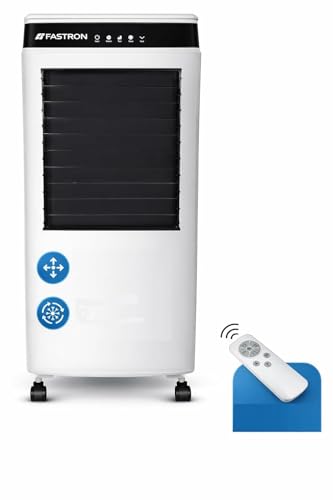
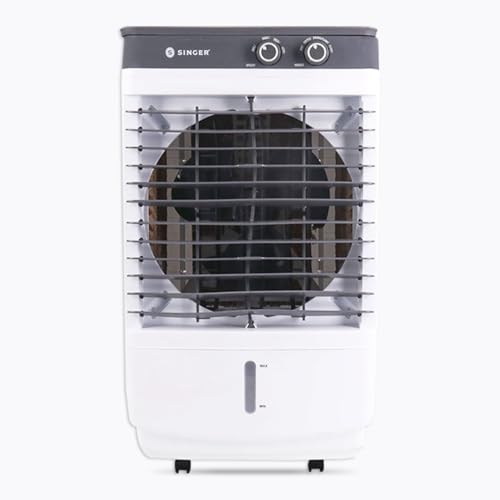
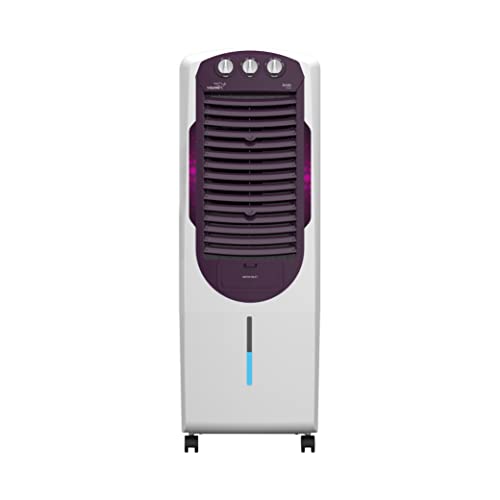
This is one of the most financially damaging air cooler buying mistakes — a ₹2,500 saving upfront can translate to a full replacement cost within 12 months. Stick to established brands with active service networks, at least a 1-year warranty, and genuine spare parts availability.
9. Ignoring Maintenance Requirements Before Purchase
Air coolers need regular seasonal maintenance — cleaning the tank, replacing or cleaning cooling pads, descaling water distribution channels, and lubricating the motor fan. Buyers who don’t factor in maintenance ease often end up with a cooler that develops a smell, reduced cooling, or fungal growth by mid-season.
Before buying, check:
→ Whether the water tank has a drain plug for easy emptying and cleaning
→ Whether the cooling pads are easily removable and replaceable with standard-size spares
→ Whether the model has an anti-bacterial or anti-dust coating on the tank interior — a feature increasingly common in mid-range and premium models
A cooler you can clean in 15 minutes will last years longer than one you avoid cleaning because it’s too difficult. If you own an air cooler, consider reading our feature on How to Clean Limescale Crust From Honeycomb Cooler Pads.
10. Not Considering Portability and Placement Flexibility
The final air cooler buying mistake that affects daily usability is underestimating how much you’ll want or need to move the unit. A 65-liter desert cooler filled with water can weigh upwards of 25–30 kg — nearly impossible to move single-handedly between rooms.
Before purchasing:
→ If you need the cooler in multiple rooms (bedroom at night, living room during the day), opt for a model with 360° castor wheels with a locking mechanism
→ For single-room use, stability is more important than mobility — choose accordingly
→ Also consider where you’ll store the cooler in winter — tall tower coolers take significantly less floor space than wide desert coolers when not in use.
Conclusion
Avoiding these 10 air cooler buying mistakes doesn’t demand technical expertise — it demands asking the right questions before you commit. Know your room size, check the airflow specs, verify climate suitability, look at pad type and motor quality, confirm inverter compatibility, and buy from a brand you can actually get serviced. Each of these takes minutes at the research stage and saves you weeks of regret mid-summer.
At GadgetVeda, we’ve already done the comparative research across brands, budgets, and real use cases. Whether you need a compact personal cooler or a high-capacity desert model for a large hall, check out our budget-wise air cooler guides to find the right match for your home — no guesswork required.




![OnePlus Nord Buds 4 Review [Price, ANC & Battery Verdict]](https://gadgetveda.com/wp-content/uploads/2026/10/OnePlus-Nord-Buds-4-Review-GadgetVeda-150x150.webp)

![5 Best Smart TVs Under ₹15,000 in India [2026]](https://gadgetveda.com/wp-content/uploads/2026/10/Best-Smart-TVs-Under-₹15000-in-India-150x150.webp)



![OnePlus Nord Buds 4 Review [Price, ANC & Battery Verdict]](https://gadgetveda.com/wp-content/uploads/2026/10/OnePlus-Nord-Buds-4-Review-GadgetVeda-300x167.webp)

![5 Best Smart TVs Under ₹15,000 in India [2026]](https://gadgetveda.com/wp-content/uploads/2026/10/Best-Smart-TVs-Under-₹15000-in-India-300x167.webp)