


Air coolers look simple from the outside, but the science behind them is what makes them so attractive for Indian summers. If you have ever wondered how air cooler works in real life, the answer is not about refrigerant gases or compressors — it is about water, airflow, and evaporation working together in a very efficient way.
In this guide, we will break down the full process step by step, explain evaporative cooling in plain language, and answer the two questions buyers ask most often: how does an air cooler work with water and how does an air cooler work without water. By the end, you will know exactly what an air cooler can do, where it works best, and why it is such a practical option for many Indian homes.
What an Air Cooler Actually Is
An air cooler is an evaporative cooling appliance that uses water and a fan to cool incoming air. Unlike an air conditioner, it does not use a compressor and refrigerant cycle. Instead, it relies on the natural cooling effect that happens when water changes from liquid to vapor
That is why air coolers are often called evaporative coolers or desert coolers. They are especially useful in hot, dry conditions because dry air allows water to evaporate faster, which improves cooling performance. This is also why air coolers are a popular choice in many parts of India where summers are scorching, but humidity is manageable.
🛒 Explore Air Coolers by Budget
Find the right cooler for your room size and budget with our category-wise picks:
➡️ Best Air Coolers Under ₹5,000 in India — Best for PG rooms, bachelors, and very small spaces
➡️ Best Air Coolers Under ₹6,000 in India — Best for personal use and compact bedrooms
➡️ Best Air Coolers Under ₹7,000 in India — Best for small families in hot, dry cities
➡️ Best Air Coolers Under ₹8,000 in India — Best for balanced cooling, tank size, and airflow
➡️ Best Air Coolers Under ₹10,000 in India — Best for larger bedrooms and everyday family use
➡️ Best Air Coolers Under ₹12,000 in India — Best for halls, living rooms, and high-capacity cooling needs
How Does an Air Cooler Work? [The Complete Guide for Indian Buyers]
Step 1: Hot Air Enters the Cooler
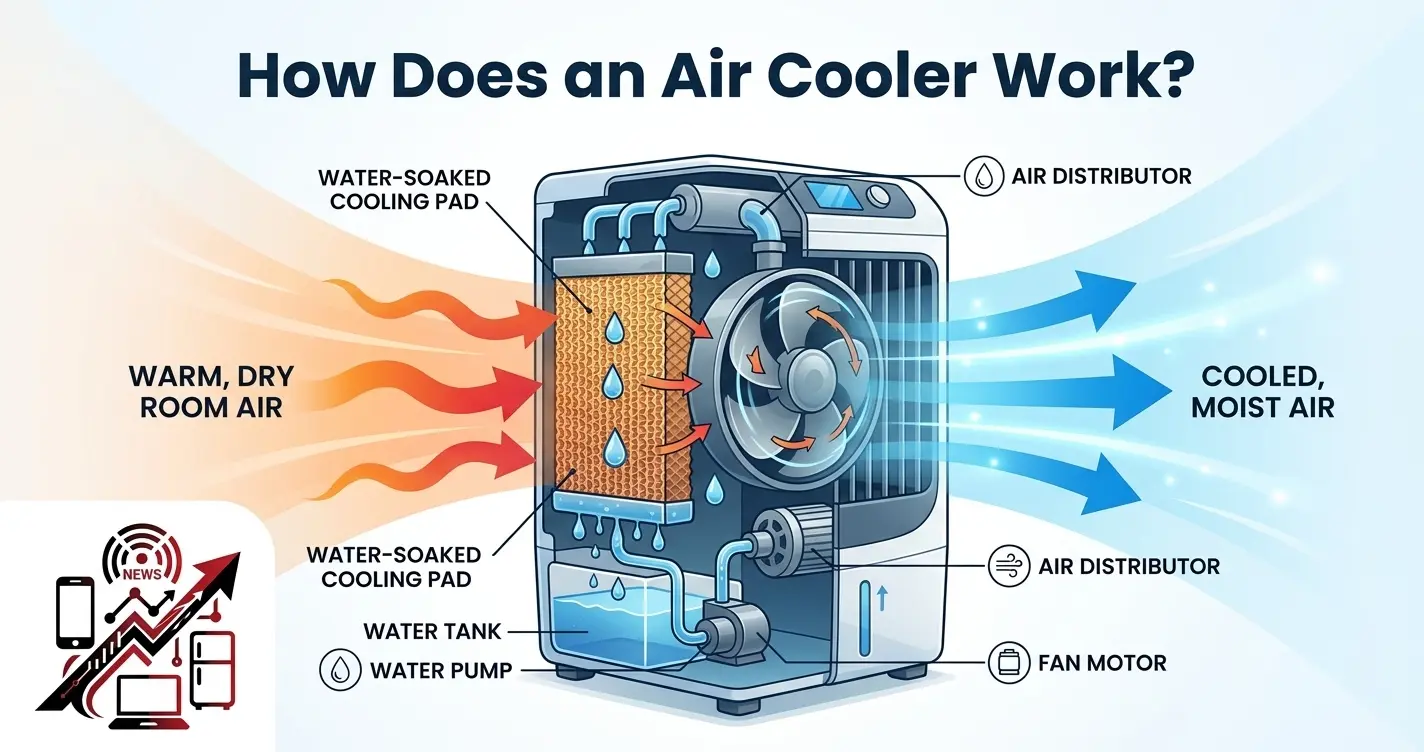
The first step in how air cooler works is simple: the fan pulls hot air from outside or from the room into the cooler body. That air is then directed toward the wet cooling pads placed inside the unit.
This matters because the cooler is not creating cold air from nothing. It is using the heat already present in the incoming air as part of the cooling process. In other words, the appliance works best when there is a steady flow of fresh air rather than a sealed room with trapped humidity.
Step 2: Water Wets the Cooling Pads
Now we come to the part most people ask about when they search for how does an air cooler work with water. Inside the cooler, a small pump sends water from the tank to the top of the cooling pads, keeping them continuously moist. These pads may be made from wood wool or honeycomb material, depending on the model.
The water spreads across the pads and creates a large wet surface area. As hot air passes through that surface, the water begins to evaporate. This is the core of the evaporative cooling process, and it is exactly why an air cooler can feel refreshing even though it is using only a fan and water.
Step 3: Evaporation absorbs heat from the air
This is the science behind evaporative cooling explained in one line: evaporation needs heat, so it pulls heat out of the surrounding air. When the water on the pads turns into vapor, it absorbs thermal energy from the air passing through the pads.
As a result, the air loses some of its heat and becomes cooler before it is blown into the room. This is the same reason a wet hand or sweaty skin can feel cooler when exposed to moving air. The cooling is natural, not mechanical, which is why air coolers use much less electricity than ACs.
Related: Common Mistakes to Avoid When Buying Air Coolers in India
Step 4: The Fan Pushes Cooled Air into the Room
After the air passes through the wet pads and loses heat, the fan pushes it out into your room as a cooler airflow. That airflow is what you feel on your skin. It is not just cooling the air; it is also creating movement that helps reduce the hot, stale feeling in the room.
This is an important distinction. Air coolers do not “freeze” the room the way an AC does. They improve comfort by combining cooler air with stronger ventilation and a light increase in humidity. In dry climates, that added moisture feels pleasant. In humid places, the same moisture can make the room feel less comfortable.
Step 5: The Tank Keeps Supplying Water
A cooler works only as long as the cooling pads remain wet. That is why the water tank is a central part of the system and not just an accessory. The pump keeps recycling water from the tank to the pads while the fan keeps moving air across them.
This also explains why runtime depends on tank size and usage. A larger tank can keep the pads wet for longer, but the actual cooling still depends on airflow, room ventilation, and humidity. If the water level drops too low, the pads dry out, and the unit stops cooling effectively, even though the fan may continue to run.
How Air Cooler Works Without Water
Many buyers search for how an air cooler works without water because they want to know whether the fan alone still does anything. The short answer is yes — but only partly.
Without water, the cooler behaves like a regular fan. It can still move air around the room and give you a breeze, but it will not provide evaporative cooling because there is no moisture on the pads to absorb heat. In practical terms, this means the appliance may feel useful on a dry evening, but it loses the main reason you bought it in the first place.
So if the pads are dry, the cooler is no longer doing its real job. This is why regular water refilling is essential, and why buyers should never treat the tank as optional.
Related: How to Choose an Air Cooler by Room Size?
Why Climate Changes the Result
An air cooler is not a one-size-fits-all product. Its performance depends heavily on the surrounding climate. In hot, dry regions, evaporation happens quickly, which makes the cooling effect stronger and more noticeable.
In humid coastal cities, the air already contains a lot of moisture, so evaporation slows down. That means the cooler still blows air, but the temperature drop is smaller and the room can feel more humid. This is why many expert guides say air coolers work best when ventilation is good, and humidity is low.
For Indian buyers, this means the same cooler can feel excellent in Jaipur or Delhi and only moderately useful in Mumbai or Kochi. The machine is the same — the environment is what changes the result.
Why Air Coolers Use Less Electricity
One big reason air coolers remain popular is power efficiency. A typical air cooler usually consumes around 180W to 200W, though some units can be a little lower or higher depending on the motor and fan design. That is far lower than an AC, which usually draws several times more power.
This low power draw is possible because the cooler is not compressing refrigerant, cycling a compressor, or running a high-load refrigeration circuit. It is simply moving air and pumping water. For households trying to manage summer bills, that difference matters a lot.
What Affects Real-World Cooling
Even if you understand how air cooler works, real-world results still depend on a few important details:]
→ Room size, because a small cooler cannot serve a large hall effectively.
→ Ventilation, because cool air needs an exit path for humid air to leave.
→ Humidity, because evaporation slows down as the air gets wetter
→ Cooling pad quality, because better pads improve water retention and airflow.
→ Maintenance, because dusty pads or low water levels reduce performance.
If these conditions are in your favor, an air cooler can feel remarkably effective. If they are not, it will feel like a large fan with limited cooling.
Air Cooler vs Air Conditioner
People often compare the two, but they solve the problem in different ways. An AC actively removes heat using refrigerant and a compressor, so it can cool a closed room more aggressively. An air cooler depends on evaporation, so it works best in a ventilated room with dry air.
That is why air coolers are usually the better choice when you want lower running costs and more natural cooling. ACs are the better choice when you need stronger, more consistent cooling in humid conditions. Understanding that difference helps you buy the right product instead of expecting one device to behave like the other. You can also check out our guide on “Air Cooler vs Air Conditioner: Which Is Better for Indian Homes?” If you need more details around this topic.
Which Users Should Choose an Air Cooler
An air cooler makes sense if you want a budget-friendly cooling solution, live in a dry or semi-dry climate, and have a room with proper airflow. It is especially useful for bedrooms, study rooms, rented homes, and households that want cooling without high electricity use.
It may not be the right fit if your room is closed, your city is highly humid, or you want AC-like cooling performance in every condition. In those cases, the technology itself is not wrong — it is just the wrong tool for the environment. If you need reliable and energy-efficient options, explore our feature Top Air Cooler Models from Symphony.
Conclusion
Now that you know how an air cooler works, the logic is simple: hot air enters, water wets the pads, evaporation absorbs heat, and a fan pushes cooler air into the room. That is the core of evaporative cooling, and it is why air coolers remain practical, affordable, and energy-efficient in the right Indian climate.
If you remember only one thing, remember this: air coolers work best with water, ventilation, and dry air. When those three conditions come together, the result is efficient summer comfort without the high running cost of an AC.




![OnePlus Nord Buds 4 Review [Price, ANC & Battery Verdict]](https://gadgetveda.com/wp-content/uploads/2026/10/OnePlus-Nord-Buds-4-Review-GadgetVeda-150x150.webp)

![5 Best Smart TVs Under ₹15,000 in India [2026]](https://gadgetveda.com/wp-content/uploads/2026/10/Best-Smart-TVs-Under-₹15000-in-India-150x150.webp)



![OnePlus Nord Buds 4 Review [Price, ANC & Battery Verdict]](https://gadgetveda.com/wp-content/uploads/2026/10/OnePlus-Nord-Buds-4-Review-GadgetVeda-300x167.webp)

![5 Best Smart TVs Under ₹15,000 in India [2026]](https://gadgetveda.com/wp-content/uploads/2026/10/Best-Smart-TVs-Under-₹15000-in-India-300x167.webp)